


.svg)


What contact center leaders should know before their next technology investment
For the past few years, industry chatter has treated voice as a dying channel. But according to fresh research from CMP, the customer contact research company, that narrative doesn't hold up. In a recent fireside chat, Tushar Kelkar, Staff Product Manager at Replicant, sat down with Nicole Kyle, Chief Product Officer at CMP, to unpack the new Future of Voice report, and the data tells a more nuanced story.
Voice preference isn't fading; it's shifting toward automation
CMP's research shows that 58% of consumers prefer a voice interaction over any other channel. What's changed is which kind of voice interaction they want. Live phone support remains the most preferred option at 42%, followed by automated voice such as voice AI agents or conversational IVR. Since 2023, the preference for automated voice has effectively doubled.
Nicole Kyle points to 2 forces driving that shift.
- The technology itself has gotten measurably better (lower latency, cleaner noise suppression, higher accuracy), and it's improving faster than ever.
- A behavioral normalization effect is happening: people are simply more used to talking to AI in everyday life, from dictating texts to querying Alexa or Google Maps. That familiarity is spilling over into how comfortable customers feel automating a service interaction.
One important nuance Kyle raised: a preference for voice doesn't automatically mean a preference for talking to a human. Speed and ease matter more to today's customers than they used to, and sometimes an automated interaction is actually the easier option.
Inside CMP's Prism methodology
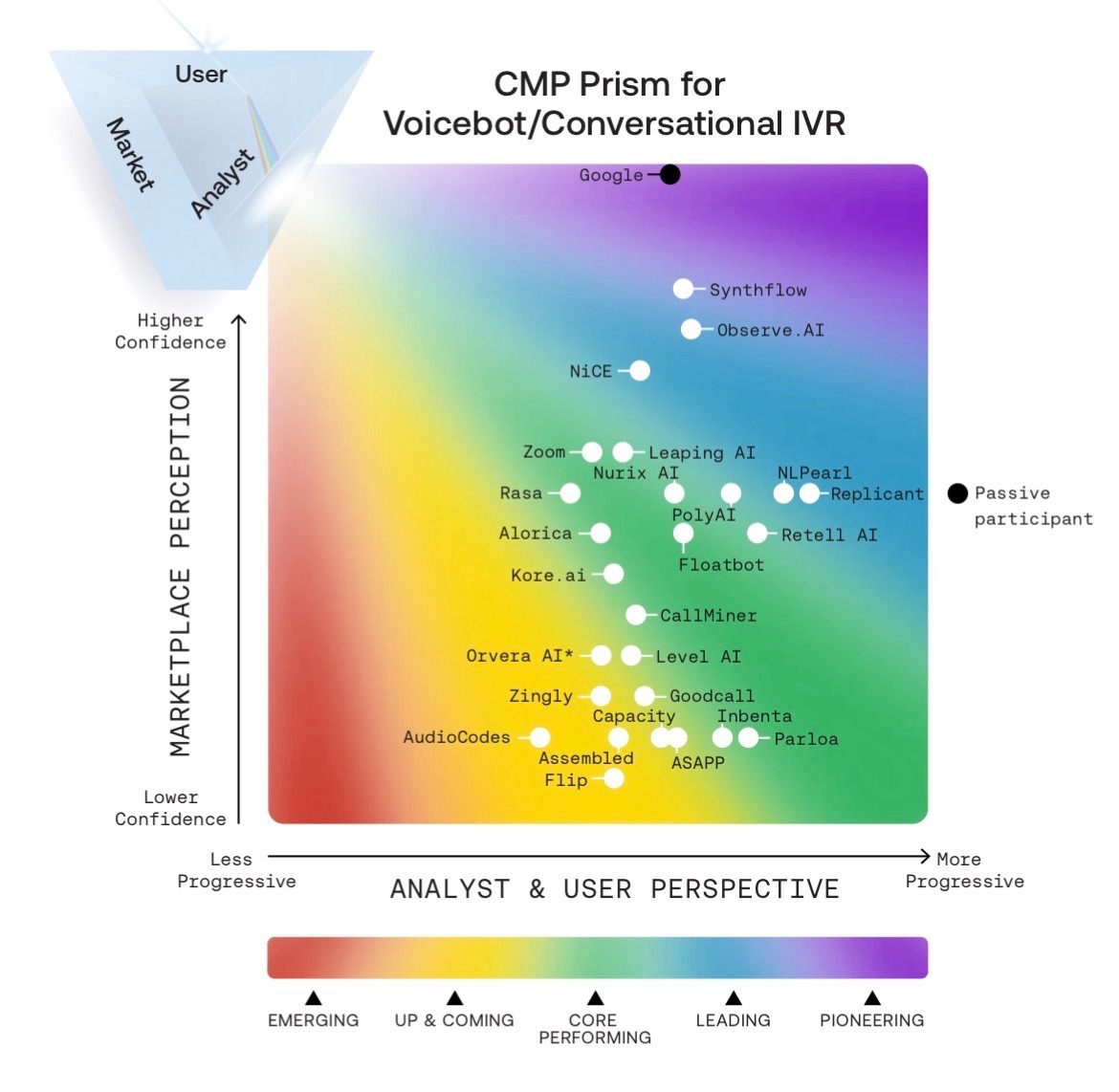
A large part of the conversation focused on how CMP actually evaluates vendors in this space, through its proprietary Prism framework. This report combines three data sources: analyst evaluation (informed by live demos and research), real-world user surveys from enterprises that have deployed the solution, and market perception data from buyers currently or recently evaluating that category.
Those inputs map to two axes:
- Market confidence (the y-axis) — a blend of awareness and perception.
- Progressiveness of capability (the x-axis) — how sophisticated the solution actually is, assessed across 10 investment criteria spanning everything from pricing and ROI to UX, customization, and implementation.
The result is a five-segment landscape: emerging, up-and-coming, core performing, leading, and pioneering. Kyle noted that vendors high on capability but not yet as well known can actually be an attractive signal for buyers: strong technology with more room to grow into a "customer of choice" position.
Across the voice bot category, CMP's survey data flagged reporting and pricing as the two biggest opportunity areas. Pricing, because ROI timelines are under pressure industry-wide, and reporting, because most vendors aren't yet turning the volume of data a voice AI agent generates into something enterprises can act on. Customer support and customization/flexibility, by contrast, came back as relative strengths across the category.
Where Replicant landed and why
Kyle confirmed that Replicant sits in the leading segment of CMP's Voice Bot Prism, as the most progressive solution provider on the capability axis. She pointed to a few specific factors behind that placement:
- Voice UX quality — low latency, clarity, and accuracy that hold up when evaluators put themselves in the customer's seat.
- Reporting and analytics — turning voice bot data into insights enterprises can use without needing a data science team. She called this a broader industry gap.
- Customization and multimodal flexibility — the ability to move between voice and chat depending on how a customer wants to be served.
- Roadmap and security posture — clear forward direction paired with the certifications enterprises expect from an AI voice provider today.
What's next: advice for the next 12 months
Looking ahead, Kyle offered a few predictions and words of caution for practitioners evaluating vendors right now:
- Avoid the "omnichannel red herring." CMP encourages an octi-channel approach instead—understanding which segments of your customer base actually want automated service and designing for them, rather than forcing every customer down the same path.
- Check your assumptions about who wants self-service. CMP's data shows the biggest increase in self-service preference came from customers aged 35–54, not the 18–34 group most practitioners assume.
- Specialist and vertical-specific bots will become a bigger differentiator. Industry-tuned automation is likely to separate leaders from the pack.
- AI co-pilots for building bots matter. Tools that let non-technical team members shape the voice experience using real interaction data rather than theoretical flowcharts are democratizing who can improve automation.
- Knowledge management is the unglamorous foundation. As Kyle put it, a voice bot is only as good as the knowledge base behind it.
- The data that informs how your AI agents work is key but also how to discover gaps and insights from every conversation.
- During Q&A, one attendee (a hospitality operator already using Replicant's Conversational Intelligence) reinforced this point, noting that visibility into why escalations happen has been the biggest gap with prior vendors and the starting point for building a real self-service roadmap.
The takeaway
Voice automation isn't replacing human conversation. It's automating the interactions where speed and ease matter more than a human touch, and that segment is growing. For contact center leaders evaluating their next investment, the research points to a clear framework: know which of your customers actually want to self-serve, start with a narrow use case, use real interaction data (not assumptions) to guide the build, and pressure-test vendors on reporting depth, not just containment rate.
You just heard where voice automation is headed, and what separates real capability from vendor claims.
The best way to know if it's real? Try it on your own conversations.
