


.svg)


Six to ten months.
That's how long some enterprises take to get AI into production. Months of evaluations. Technical reviews. Security assessments. Workflow design. Integrations. Testing. And after all that effort, many organizations are still limited to basic chatbot experiences.
The irony of customer service automation is that success creates a harder problem. The easy interactions stay digital. The difficult ones escalate to voice, where contact centers handle a higher concentration of complex, emotional, and unpredictable conversations. That's why automating voice is fundamentally different from deploying a chatbot.
Many CIOs and CTOs are asking a difficult question: If it takes six to ten months to get a chatbot into production, how long will it take to automate voice?
The answer can't be another year. Organizations don't have that kind of time. And that's the challenge many organizations face as they work to turn AI investments into production outcomes.
AI must do more than demonstrate impressive capabilities in a controlled environment. It must resolve real customer requests, operate within business policies, and deliver measurable outcomes at scale.
Companies need to find the fastest path from insight to production.
The cost of moving slowly
The impact goes beyond delayed projects. Every month spent validating assumptions is a month without customer insights, automation outcomes, or measurable return.
We've seen organizations spend months designing workflows and integrations for chatbot deployments that struggled to expand into more complex voice interactions. Others have spent months launching AI experiences that could only handle basic deflection scenarios, forcing customers into agent transfers whenever conversations became complex.
The result is predictable:
- Heavy engineering investment
- Long deployment timelines
- Limited automation rates
- Slow time to value
- Executive frustration
Organizations aren't looking for another pilot. They're looking for a clear path to production. They need a repeatable way to identify where AI will create value, prove it quickly, and scale it confidently.
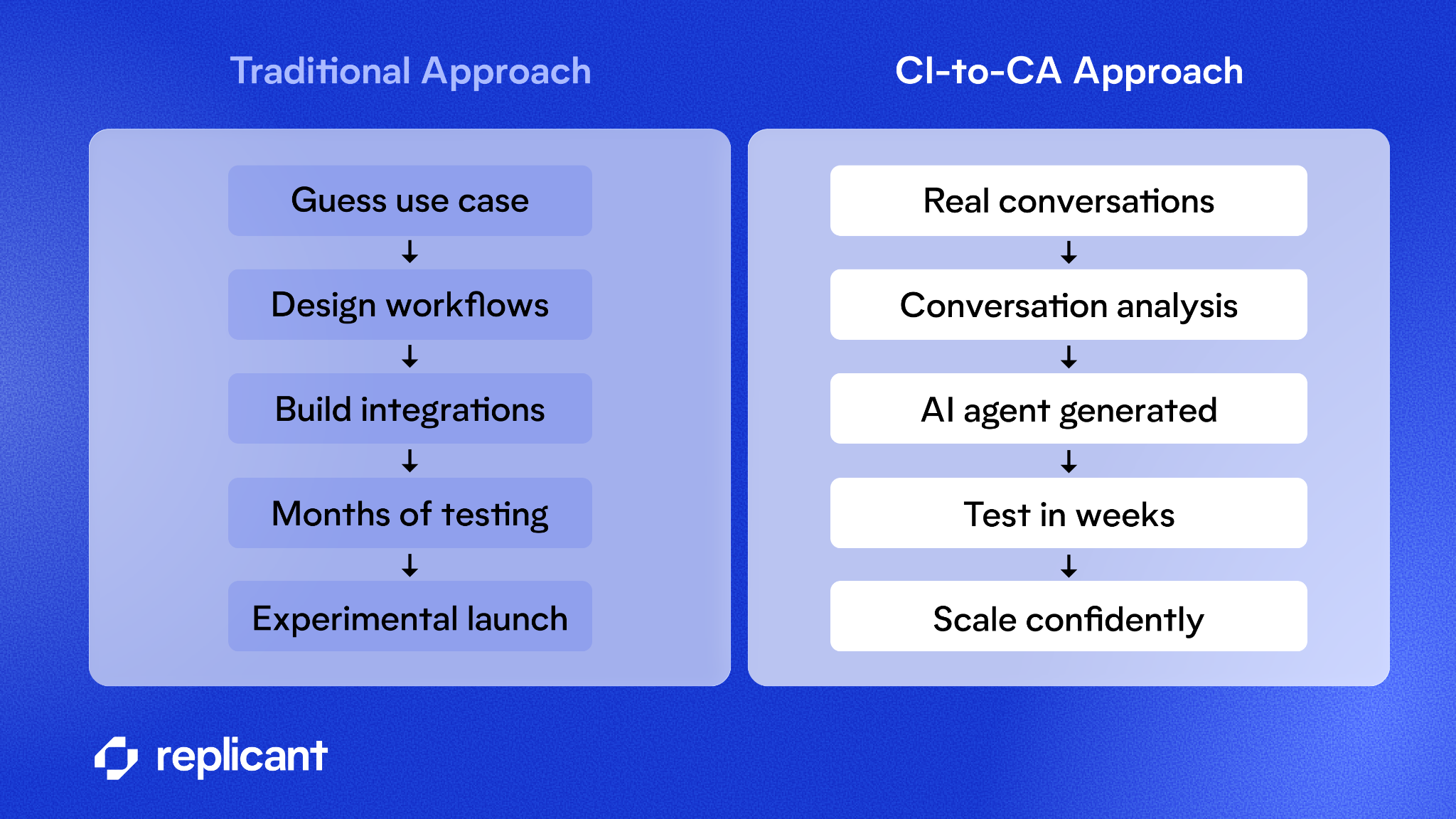
The traditional evaluation approach starts with a use case. Workflows are designed. Business rules are documented. AI is configured. Testing begins. Only later do organizations discover that the assumptions were wrong.
- What if the issue driving call volume isn't what leadership believed?
- What if customers aren't following the documented workflows?
- What if top-performing agents are resolving issues in ways nobody captured?
This is where many AI initiatives lose momentum because they are built around assumptions rather than evidence.
Start with conversations, not workflows
We call it Conversation Intelligence-to-Conversation Automation (CI-to-CA): a process that turns customer conversations into actionable insights and translates them into automation.
Most organizations start by guessing what to automate and manually designing workflows. CI-to-CA flips that process. By analyzing real customer conversations first, organizations can identify where automation will have the greatest impact, understand how their best agents resolve issues, and generate AI agents based on proven resolution patterns rather than assumptions.
Within one hour, organizations gain visibility into:
- Why customers are calling
- High-volume and high-effort interactions
- Opportunities for automation
- Behaviors of top-performing agents
- Common friction points across customer journeys
Often, the findings challenge long-held assumptions.
- One enterprise financial services company believed payment issues were the primary driver of customer contacts. After analyzing thousands of conversations, the actual source of customer frustration turned out to be their mobile application experience.
- Another organization believed customer friction was occurring throughout the service journey. Conversation analysis revealed the primary issue was scheduling services. Those insights helped leadership prioritize investment in a Field Service Management platform rather than continuing to focus on symptoms.
That's the value of starting with your own conversation data: uncovering what actually drives customer effort before investing in automation.
From insight to automation in weeks
Understanding the problem is only the first step. The next step is proving that automation can solve it and create value fast enough to scale. Using insights from your conversation data, Replicant generates a callable AI agent modeled on the behaviors, workflows, and expertise of your best agents.
Through Conversation Intelligence, organizations gain visibility into why customers contact them, which interactions require the most effort, and where automation can have the greatest impact. Those insights are then translated into a working AI agent through Conversation Automation.
Within one hour, organizations can interact with a callable AI agent built from their own conversation data. Within two weeks, they can test performance, refine policies, evaluate outcomes, and determine where automation should scale. This approach changes the conversation from "Can AI handle this use case?" to "Where can AI create measurable business value?"
More importantly, it creates a faster path to production.
Instead of spending months designing workflows and validating assumptions, organizations can quickly identify automation opportunities, prove outcomes, and expand into additional use cases. The result is a scalable operating model that moves from insight to automation, automation to outcomes, and outcomes to scale.
That's how leading enterprises are closing the gap between AI hype and AI scale. Not by running more pilots. By turning real customer conversations into automation that scales.
Book an intro to speak with an expert and learn more about our CI-to-CA approach.
