


.svg)


A joint perspective by Vedra AI and Replicant
Straight-through processing has been a fixture of insurance industry conversation for years. The premise is straightforward: a claim arrives, AI handles it end-to-end, and the policyholder receives their resolution without a human ever entering the picture. For a low-impact collision with clear photographs and a valid policy, there is genuinely no reason one should.
Yet the front door of the claims process — the first notice of loss call — has remained stubbornly manual. A policyholder contacts their insurer; a live agent answers; the agent works through the same fifteen questions they have asked a thousand times before; enters the answers into a system; and only then does any form of AI take over.
Replicant and Vedra AI are closing that gap. Together.
“Replicant and Vedra AI are turning the first call into the final step — automating insurance claims from first notice of loss to resolution.”
01 — The moment that sets everything in motion
When a policyholder has an accident, they call. That remains the dominant behavior for auto claims — because people want to speak with someone when they are stressed, confused, and possibly stranded on the side of a road.
Replicant's conversational AI answers that call. Not an IVR. Not a chatbot dressed up as a voice agent. A purpose-built voice AI trained on millions of insurance interactions, designed to manage the full FNOL intake conversation:
- Verify policy details and collect incident information
- Understand what happened using natural language — not scripted menus
- Guide the policyholder through submitting damage photos via SMS link, right in the moment
By the time the call ends, Replicant have produced something that almost never exists at first notice of loss: a complete, structured, validated claim record with incident details, policy confirmation, and damage photos attached. That record is handed directly to Vedra AI.
02 — What Vedra AI does with it
Vedra AI is an AI orchestration platform built for P&C insurers. Rather than displacing a carrier's existing technology stack, Vedra operates as the intelligence layer above it — coordinating best-in-class AI models across the claims workflow. The moment Replicant's structured FNOL data arrives, four models go to work simultaneously.
Computer Vision — Damage Assessment
The photos captured during the Replicant call are immediately processed by Vedra AI's computer vision AI. The model classifies damage type, estimates severity, identifies affected panels, and determines whether the claim is eligible for automated processing. A minor rear bumper scratch appearing in well-lit, consistent-angle photos? Straight-through eligible. Extensive damage or frame deformation? A human adjuster is needed, and the claim exits the STP path immediately.
Coverage and Policy Verification
Simultaneously, Vedra AI creates the claim in the systems of records, and cross-references it against the policyholder's coverage profile — confirming deductibles, coverage applicability, and any exclusions relevant to the reported incident. A task that traditionally takes an adjuster hours now runs in seconds.
Fraud Signal Detection
AI models compare the claim against behavioral patterns, prior claim history, and image metadata — flagging anomalies such as timestamp inconsistencies across photos, prior claims on the same vehicle, or damage patterns that do not align with the described incident. Any meaningful signal pulls the claim out of the automated path before it advances further.
STP Eligibility Scoring
Vedra AI's orchestration layer, the fourth model, synthesizes outputs from all three models into a single eligibility score. If the claim clears the threshold — minor damage, verified coverage, clean fraud signals — the determination is made: this one goes straight through.
By the time Vedra AI's four models have finished their work — vision, coverage, fraud, and eligibility — a claim that once took days to assess has been evaluated, validated, and scored in seconds.
03 — Closing the loop in Guidewire
For P&C insurers running Guidewire ClaimCenter, this is where automation completes the circle. Vedra AI presents the fully enriched claim record directly into Guidewire — pre-populated with FNOL data from Replicant, computer vision assessment results, coverage verification status, and the STP determination.
For STP-eligible claims, the claim is created and advanced through the settlement workflow with a simple review from the adjuster. For claims that don't qualify, Guidewire routes the enriched record to the correct adjuster queue with all preliminary work already done. No re-keying. No hunting for photos. No calling the policyholder back for information that should have been captured on the first call.
The adjuster opens the file and sees everything they need to make a decision.
04 — The numbers
On a typical auto physical damage claim eligible for straight-through processing:
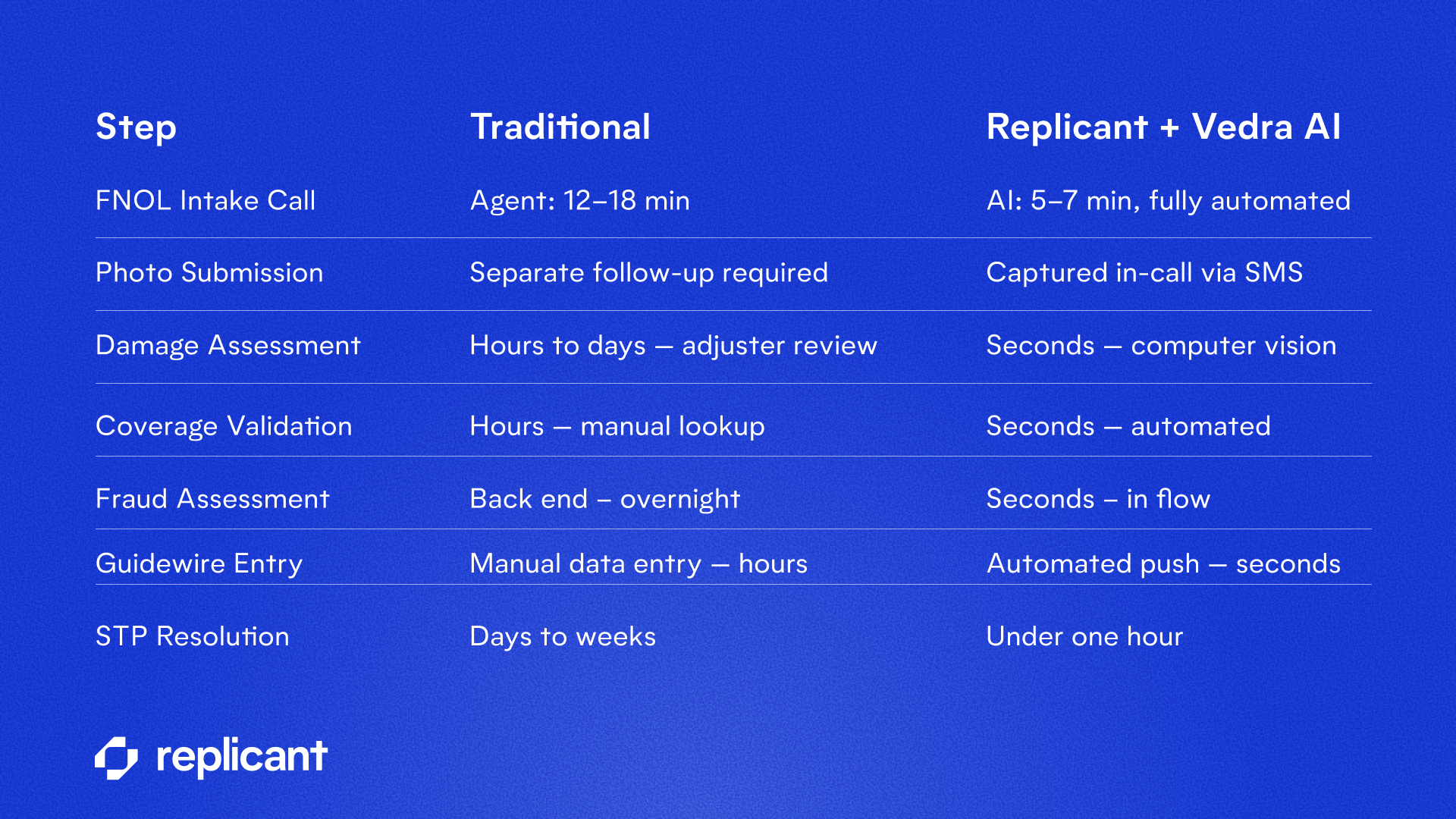
Insurers processing thousands of auto claims per month could route 15-20% of volume through an STP channel, and an additional 20-25% of the claims through an express channel — producing meaningful savings in both operating cost and policyholder satisfaction.
05 — Why the partnership works
Replicant handles the conversation. Vedra AI handles the orchestration. Neither company tries to do the other's job. What makes this integration compelling is not simply that both platforms perform well in isolation — it is that the output of one is precisely the input the other is built to consume.
Replicant produces clean, structured, photo-rich FNOL data. Vedra AI's models are designed to act on exactly that. Guidewire provides the system of record where everything lands. No new hardware. No additional training for the carrier's team. No new headcount. Two purpose-built AI systems, integrated with infrastructure the carrier was already running.
06 — What comes next
The STP use case is the first of several workflows Replicant and Vedra AI are building together. The same underlying model — conversational intake feeding AI orchestration feeding Guidewire — extends naturally to:
- Claim status updates and proactive outbound communication
- Total loss determinations
- Subrogation triggers
- Customer touchpoints at key milestones throughout the claim lifecycle
The goal is not to automate everything. It is to deliver consistent speed and service from first call to final payment — and to reserve human judgment for the moments where it genuinely matters.
That begins with getting the first notice of loss right.
Schedule time with an expert to see this workflow in action.
