
Quick summary
Looking for a CallMiner alternative? CallMiner has established itself as a leading conversation intelligence platform, but it's not the right fit for every contact center. This article examines seven strong alternatives to CallMiner, each with distinct capabilities ranging from pure analytics to integrated automation solutions. You'll learn about the specific limitations that drive organizations to explore alternatives, as well as detailed comparisons of features and pricing for competitors including Replicant, Observe.AI, Cresta, Verint, Calbrio, NICE, and Talkdesk. Finally, you’ll get guidance on selecting the platform that best matches your contact center's needs and infrastructure.
We’ll also explore how Replicant’s Conversation Intelligence compares, and why it may be the right fit for your team.
What is CallMiner?
CallMiner is a conversation intelligence platform that analyzes customer interactions across voice and digital channels. Organizations use CallMiner to review recorded conversations, identify patterns in customer behavior, monitor compliance adherence, and coach agents based on performance data. The platform processes large volumes of interaction data to surface insights that would be impossible to uncover through manual review alone.
Key features
CallMiner's core capabilities center on extracting value from customer conversations:
- Speech and text analytics: Automatically transcribes and analyzes conversations across channels, identifying keywords, phrases, and topics that indicate customer needs or pain points
- Sentiment detection: Evaluates emotional tone throughout interactions to understand customer satisfaction and identify moments of friction or delight
- Compliance monitoring: Tracks adherence to regulatory requirements and internal policies, flagging conversations that may pose compliance risks
- Agent coaching: Provides performance metrics and conversation examples that supervisors can use to improve agent skills and consistency
- Deep analytics: Offers comprehensive reporting and visualization tools that help leaders understand trends, patterns, and opportunities across their entire contact center operation
These features position CallMiner as a comprehensive analytics solution for organizations that need to understand what's happening in their customer conversations and why.
Why consider CallMiner alternatives? Common limitations
Several legitimate business reasons drive contact centers to explore alternatives to CallMiner. Understanding these limitations helps clarify what to look for in a conversation intelligence platform.
Steep learning curve
CallMiner's comprehensive feature set comes with significant complexity. New users often require extensive training to understand the platform's capabilities and navigate its interface effectively. Implementation teams report that achieving full value from CallMiner can take several months, which extends time-to-value and requires sustained commitment from both technical and business teams. Smaller contact centers or organizations that need quick wins may find this ramp-up period challenging, particularly when they're under pressure to demonstrate ROI from their technology investments.
Cost concerns
CallMiner's pricing structure reflects its position as an enterprise-focused solution. Mid-market organizations frequently find the total cost of ownership prohibitive, especially when factoring in licensing fees, implementation costs, and ongoing support requirements. The platform's value increases with scale, but smaller contact centers may struggle to justify the investment when they're handling lower call volumes. Organizations operating on tight budgets or those that need to prove the concept before committing to a full deployment often seek alternatives with more flexible pricing models or lower entry points.
Real-time gaps
While CallMiner excels at historical analysis and trend identification, its real-time capabilities are more limited. Contact centers that prioritize live coaching and immediate intervention during customer conversations may find the platform doesn't provide the instantaneous insights they need. Supervisors who want to guide agents during active calls or systems that need to trigger immediate actions based on conversation content require stronger real-time processing. This limitation becomes particularly noticeable in high-stakes situations where delays in insight delivery can mean missed opportunities to save customer relationships.
Integration limits
CallMiner integrates with major enterprise platforms, but organizations with diverse or specialized tech stacks sometimes encounter compatibility challenges. Contact centers using less common CRM systems, homegrown tools, or newer cloud-native platforms may face extended integration timelines or discover that certain connections aren't feasible. These integration gaps can create data silos that limit the platform's effectiveness, forcing teams to maintain multiple systems or accept incomplete visibility into their operations.
Scalability challenges
CallMiner is powerful, but that power comes with infrastructure requirements. Organizations report that scaling the platform to handle increased conversation volumes or add new use cases often requires significant IT resources and careful planning. The platform's architecture can be resource-intensive, demanding substantial computing power and storage capacity. Contact centers experiencing rapid growth or those with highly variable call volumes may find these scaling challenges create bottlenecks. Teams with limited IT support or those operating in resource-constrained environments frequently seek alternatives that offer easier scalability without extensive technical overhead.
7 best CallMiner competitors for contact center analytics
Several platforms have emerged as strong alternatives to CallMiner, each addressing different needs within the conversation intelligence market. These solutions range from analytics-focused tools to platforms that combine insights with contact center automation capabilities. Read on to learn more about the following 7 CallMiner alternatives:
1. Replicant Conversation Intelligence
2. Observe.AI
3. Cresta
4. Verint Speech Analytics
5. Calabrio Analytics
6. NICE Interaction Analytics
7. Talkdesk Interaction Analytics
1. Replicant Conversation Intelligence
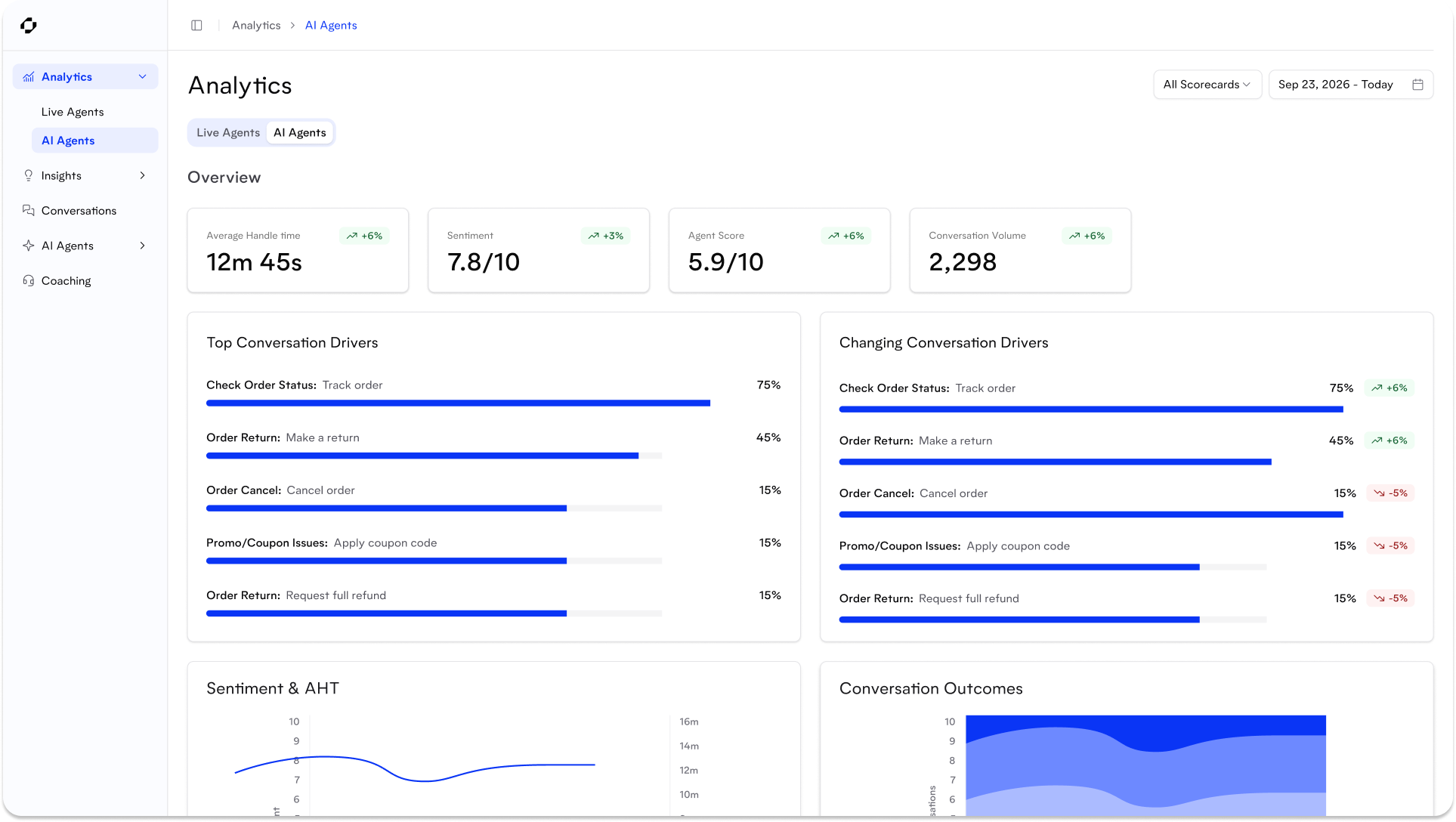
Replicant takes a unique approach by combining Conversation Intelligence with conversation automation in a single platform. This dual capability means organizations don't just gain insights from their customer interactions, they can also automate routine conversations based on what the analytics reveal. Contact centers use Replicant to analyze 100% of their calls while simultaneously reducing call volume through intelligent AI agents that handle common requests.
Key features
- Multi-modal LLM analysis: Uses advanced language models to analyze both audio and text signals, capturing nuances that transcript-only systems miss, including tone, pace, and emotional indicators that reveal the true nature of customer interactions
- Audio-based insights: Collects signals directly from call audio to detect subtleties like long hold times, lack of empathy, mumbling, heavy accents, and agent rudeness that traditional keyword-based systems overlook
- Proactive alerts and dashboards: Provides natural language summaries when critical patterns emerge, such as spikes in specific call types or unresolved customer issues, allowing leaders to take immediate action rather than waiting for scheduled reports
- Complete call summaries: Automatically generates comprehensive, objective summaries of every interaction, drastically reducing after-call work while ensuring teams capture the full context and nuance of each conversation
- Agent scoring and coaching recommendations: Evaluates agent performance using customizable scorecards and provides specific, data-driven coaching suggestions that help supervisors address performance gaps faster and more effectively
- Smart suggestions for knowledge base: Identifies opportunities to improve knowledge bases by learning from the responses of top-performing agents, ensuring documentation stays current and reflects proven approaches to common customer issues
- Automation opportunity identification: Analyzes conversation patterns to pinpoint repetitive, high-volume workflows that are ideal candidates for automation, creating a clear roadmap for reducing agent workload while maintaining service quality. This capability helps turn on the lights in your contact center, revealing exactly where automation can deliver the greatest impact while ensuring teams maintain the service standards customers expect
Pricing: Replicant uses custom enterprise pricing based on conversation volume and specific use cases. The platform includes both conversation intelligence and automation capabilities in its core offering, with resolution-based pricing for automated interactions.
Pros:
- Goes beyond pure analytics to actually reduce call volume through automation
- Analyzes 100% of customer conversations rather than sampling
- Provides real-time insights that enable immediate coaching and intervention
- Reduces agent workload through automated call summaries and administrative tasks
- Replicant integrations are enterprise-ready for major contact center and CRM platforms
Cons:
- Enterprise-focused; may be more robust than needed for SMBs
2. Observe.AI
Observe.AI focuses specifically on quality assurance and agent performance improvement. The platform automated
the traditionally manual QA process, allowing teams to review 100% of interactions rather than relying on small samples. Organizations choose Observe.AI when agent coaching and quality management are their primary concerns, particularly when they want to move beyond random sampling to comprehensive interaction analysis.
Key features
- Automated QA: Eliminates manual call reviews by automatically scoring every interaction against customizable quality criteria, ensuring consistent evaluation across all agents and identifying coaching opportunities that would otherwise remain hidden
- Real-time guidance: Provides agents with in-the-moment suggestions during live calls, helping them navigate complex situations and maintain quality standards without supervisor intervention
- Conversation analytics: Breaks down interactions by topic, sentiment, and outcome to reveal patterns in customer behavior and agent performance across the entire contact center
- Coaching workflows: Creates structured coaching programs based on actual interaction data, allowing supervisors to assign specific development activities tied to real examples from agent calls
- Compliance monitoring: Flags conversations that may violate regulatory requirements or internal policies, providing audit trails and documentation for compliance teams
Pricing: Observe.AI uses a subscription-based model with per-agent pricing. The cost scales with the number of agents being monitored and the features selected.
Pros:
- Strong coaching tools that connect insights directly to agent development
- User-friendly interface that reduces training time for supervisors and QA teams
- Good integration options with major contact center platforms
- Established presence in the QA space with proven implementations
Cons:
- Limited automation capabilities beyond agent assist features
- Can become expensive at scale when monitoring large agent populations
3. Cresta
Cresta specializes in real-time agent assistance combined with performance analytics. The platform monitors live conversations and provides agents with dynamic guidance drawn from top performer behaviors. Contact centers implementing Cresta typically prioritize improving agent performance during active calls rather than focusing solely on post-call analysis and coaching.
Key features
- Live agent guidance: Monitors conversations in real-time and surfaces relevant knowledge articles, suggested responses, and next-best-actions based on what top performers do in similar situations
- Performance dashboards: Displays agent and team metrics in customizable views that help supervisors understand who's excelling, who needs support, and where systematic issues exist
- Behavioral insights: Analyzes what separates top performers from average agents, identifying specific phrases, techniques, and approaches that drive better outcomes
- Knowledge suggestions: Automatically recommends relevant information from the knowledge base during conversations, ensuring agents have the right answers at the right moment
- Conversation analysis: Reviews completed interactions to identify trends, common customer issues, and opportunities for process improvement
Pricing: Cresta uses custom enterprise pricing based on agent count and deployment complexity.
Pros:
- Excellent real-time capabilities that support agents during active conversations
- Strong AI coaching that learns from best practices within the organization
- Proven track record with large enterprise contact centers
- Integrates with major CCaaS and CRM platforms
Cons:
- Focused primarily on agent assist rather than comprehensive analytics
- Premium pricing that may be prohibitive for mid-market organizations
4. Verint Speech Analytics
Verint brings decades of experience in workforce optimization to its speech analytics offering. The platform emphasizes compliance monitoring and customer experience analysis, making it particularly popular in regulated industries like financial services and healthcare. Organizations choose Verint when they need robust compliance features alongside their analytics capabilities.
Key features
- Speech and text analysis: Processes conversations across channels to identify keywords, topics, and patterns that indicate customer needs, compliance risks, or operational issues
- Compliance recording: Maintains secure, tamper-proof records of customer interactions with audit trails that meet regulatory requirements in highly regulated industries
- Trend identification: Surfaces emerging patterns in customer behavior, product issues, or service gaps before they escalate into larger problems
- Customer journey mapping: Connects individual interactions to broader customer journeys, revealing how different touchpoints influence overall satisfaction and outcomes
- Integration capabilities: Connects with Verint's broader workforce optimization suite and third-party platforms to create unified views of contact center operations
Pricing: Verint uses an enterprise licensing model with pricing based on agent count, features selected, and deployment size.
Pros:
- Deep compliance features built specifically for regulated industries
- Proven implementation experience in banking, insurance, and healthcare
- Extensive reporting capabilities that satisfy audit and regulatory requirements
- Strong brand recognition and established customer base
Cons:
- Complex implementation that often requires significant professional services
- Interface and user experience can feel dated compared to newer cloud-native platforms
5. Calabrio Analytics
Calabrio positions its analytics platform as part of a broader workforce optimization suite. The platform appeals to contact centers that want to connect conversation insights with workforce management, quality management, and agent scheduling. Organizations already using Calabrio for WFM often expand to include the analytics capabilities for a more integrated approach.
Key features
- Call recording and analysis: Captures and analyzes customer interactions with tools for searching, reviewing, and scoring conversations based on customizable criteria
- Quality management: Provides structured evaluation workflows that help QA teams assess agent performance consistently across the organization
- Workforce management integration: Connects conversation insights with staffing patterns to understand how schedule adherence, occupancy, and workload affect interaction quality
- Desktop analytics: Monitors agent desktop activity to identify inefficient processes, application switching, and time spent on after-call work
- Customizable dashboards: Allows teams to build views that display the specific metrics and trends most relevant to their operational priorities
Pricing: Calabrio offers both subscription and perpetual licensing options, with pricing based on concurrent users and selected modules.
Pros:
- User-friendly interface that reduces training requirements
- Strong integration with workforce management tools
- Well-suited for mid-market organizations
- Reasonable pricing compared to enterprise-only platforms
Cons:
- Less advanced AI capabilities compared to newer platforms
- Limited real-time features for live coaching and intervention
6. NICE Interaction Analytics
NICE offers enterprise-grade analytics as part of its broader CXone platform. The solution provides comprehensive reporting and analysis capabilities designed for large, complex contact center environments. Organizations running NICE for their CCaaS infrastructure often adopt the analytics components for tighter integration and unified management.
Key features
- Omnichannel analytics: Analyzes interactions across voice, chat, email, and social channels to provide complete visibility into customer communication patterns
- Predictive insights: Uses historical interaction data to forecast trends, anticipate customer needs, and identify potential issues before they impact service levels
- Automation recommendations: Identifies opportunities to automate routine interactions based on conversation patterns and resolution data
- Compliance tools: Monitors adherence to scripts, disclosures, and regulatory requirements with automated alerts when violations occur
- Customizable reporting: Provides extensive options for building reports and dashboards tailored to specific business requirements and KPIs
Pricing: NICE uses enterprise licensing with volume-based pricing that scales with contact center size and feature selection.
Pros:
- Comprehensive feature set that addresses diverse analytics needs
- Strong enterprise support with dedicated account teams
- Proven ability to handle massive conversation volumes at scale
- Extensive integration options with both NICE and third-party platforms
Cons:
- High cost that puts it out of reach for many mid-market organizations
- Complex setup and maintenance that requires dedicated IT resources
7. Talkdesk Interaction Analytics
Talkdesk built its analytics capabilities natively into its cloud contact center platform. This approach creates seamless data flow between the CCaaS infrastructure and the analytics layer. Organizations already committed to the Talkdesk ecosystem find the integrated analytics a natural extension that requires minimal additional setup.
Key features
- AI-powered insights: Applies machine learning to conversation data to automatically identify trends, anomalies, and opportunities without requiring manual configuration
- Sentiment analysis: Evaluates customer emotional state throughout interactions to understand satisfaction levels and identify moments that drive positive or negative experiences
- Agent performance tracking: Monitors individual and team metrics to reveal coaching opportunities and recognize high performers
- Customer experience management: Connects interaction data with broader CX initiatives to understand how contact center performance affects overall customer relationships
- Native Platform Integration: Leverages tight integration with the Talkdesk CCaaS platform for real-time data access and simplified deployment
Pricing: Talkdesk offers subscription-based pricing with tiered plans that include different levels of analytics functionality.
Pros:
- Seamless experience for organizations already using the Talkdesk platform
- Modern, intuitive interface that requires minimal training
- Good fit for cloud-first organizations
- Faster deployment compared to platforms requiring extensive integration work
Cons:
- Works best within the Talkdesk ecosystem
- Limited standalone capabilities for organizations using other CCaaS platforms
How to choose the right CallMiner alternative
Selecting the right conversation intelligence platform requires careful evaluation of your specific requirements rather than simply choosing the most feature-rich or well-known option. The best CallMiner alternative for your organization depends on your existing technology infrastructure, strategic priorities, and operational constraints.
Integration requirements should guide your initial filtering. Contact centers with established tech stacks need platforms that connect seamlessly with their CRM systems, CCaaS platforms, and business intelligence tools. Organizations using Salesforce, Zendesk, or Genesys should prioritize vendors with proven integrations for these systems. Contact centers with custom or less common platforms need to evaluate API flexibility and determine whether they'll need middleware or professional services to achieve the connections they require.
Real-time vs. historical analysis represents a fundamental decision about how you'll use conversation intelligence. Contact centers that want to coach agents during live calls or trigger immediate interventions need platforms with strong real-time processing capabilities like Cresta or Replicant. Organizations focused on identifying long-term trends, compliance patterns, and strategic opportunities may prioritize the depth of historical analysis that platforms like Verint or NICE provide.
Automation capabilities matter increasingly as contact centers look beyond insights to actual operational improvement. Platforms like Replicant that combine conversation intelligence with automation allow organizations to both understand their conversations and reduce call volume based on what the data reveals. Contact centers that simply want analytics should focus on pure-play solutions, while those seeking to transform their operations should consider integrated platforms that turn insights into action.
Scalability and performance determine whether a platform can grow with your organization. Contact centers experiencing rapid growth need solutions that handle increasing conversation volumes without degrading performance or requiring constant infrastructure upgrades. Evaluate how each platform processes high call volumes, whether it can accommodate seasonal spikes, and what resources are required to maintain performance at scale.
Security and compliance requirements become critical when processing sensitive customer conversations. Organizations handling PII, payment data, or regulated information need platforms with robust security frameworks. Contact centers should evaluate features like Replicant safety and security capabilities, which include data encryption, access controls, and compliance certifications that meet industry standards.
Total cost of ownership extends far beyond licensing fees. Factor in implementation costs, professional services, training requirements, ongoing maintenance, and the internal resources needed to manage the platform. A lower-priced solution that requires extensive customization and dedicated IT support may ultimately cost more than a premium platform with faster deployment and managed services.
FAQs
What are the best CallMiner competitors in 2026?
Some of the best CallMiner competitors include Replicant Conversation Intelligence, Observe.AI, Cresta, Verint Speech Analytics, Calabrio Analytics, NICE Interaction Analytics, and Talkdesk Interaction Analytics. Each platform serves different needs, from real-time coaching to compliance-focused analytics or integrated automation.
Why do contact centers look for CallMiner alternatives?
Contact centers often explore CallMiner alternatives due to factors like high cost, long implementation timelines, limited real-time insights, or integration challenges. Some teams also want platforms that go beyond analytics and help reduce call volume through automation, not just analyze past conversations.
Is CallMiner good for real-time conversation intelligence?
CallMiner is strong at historical analysis and trend discovery, but its real-time capabilities are more limited compared to newer platforms. Contact centers that prioritize live coaching, immediate alerts, or real-time automation often look to alternatives that process conversations as they happen.
How should I choose the right CallMiner alternative for my contact center?
The right CallMiner alternative depends on your goals, existing tech stack, and operational priorities. Teams should evaluate factors like real-time vs. historical insights, integration requirements, automation capabilities, scalability, and total cost of ownership. The best platform is the one that solves your specific problems, not just the one with the longest feature list.
Conclusion
Each alternative covered in this article addresses different pain points and priorities. Organizations prioritizing quality management should evaluate Observe.AI or Calabrio. Those focused on real-time agent guidance will find value in Cresta. Contact centers in regulated industries may prefer Verint's compliance-focused approach. Teams already committed to specific CCaaS platforms should consider the native analytics from NICE or Talkdesk.
Replicant stands apart by combining conversation intelligence with conversation automation, allowing contact centers to both understand their interactions and systematically reduce routine call volume. This integrated approach means insights directly inform which conversations to automate, while automation performance feeds back into the intelligence platform, creating a continuous improvement cycle that pure analytics solutions cannot provide.
Check out our blog for on-going insights into how automation works.