AI building AI building AI
It’s never been easier to spin up an AI demo. Foundation models are setting new intelligence benchmarks every couple months and we’ve reached the point that, with a few clicks and a simple prompt, it’s possible to showcase something that feels like magic.
In other words, AI isn’t the hard part anymore. But production is a different story.
Deploying high-resolution AI Agents fast, safely, and repeatedly requires far more than a prompt and a smart model. It requires structure, validation, and control. Without these pieces, AI performance reaches a plateau in capabilities, and enterprises get stuck in what can feel like a proof-of-concept purgatory.
At Replicant, we’ve focused not just on building AI Agents, but on building a system for constructing and delivering them. A system where AI is involved in every layer, and where every layer is still reviewable, testable, and governed.
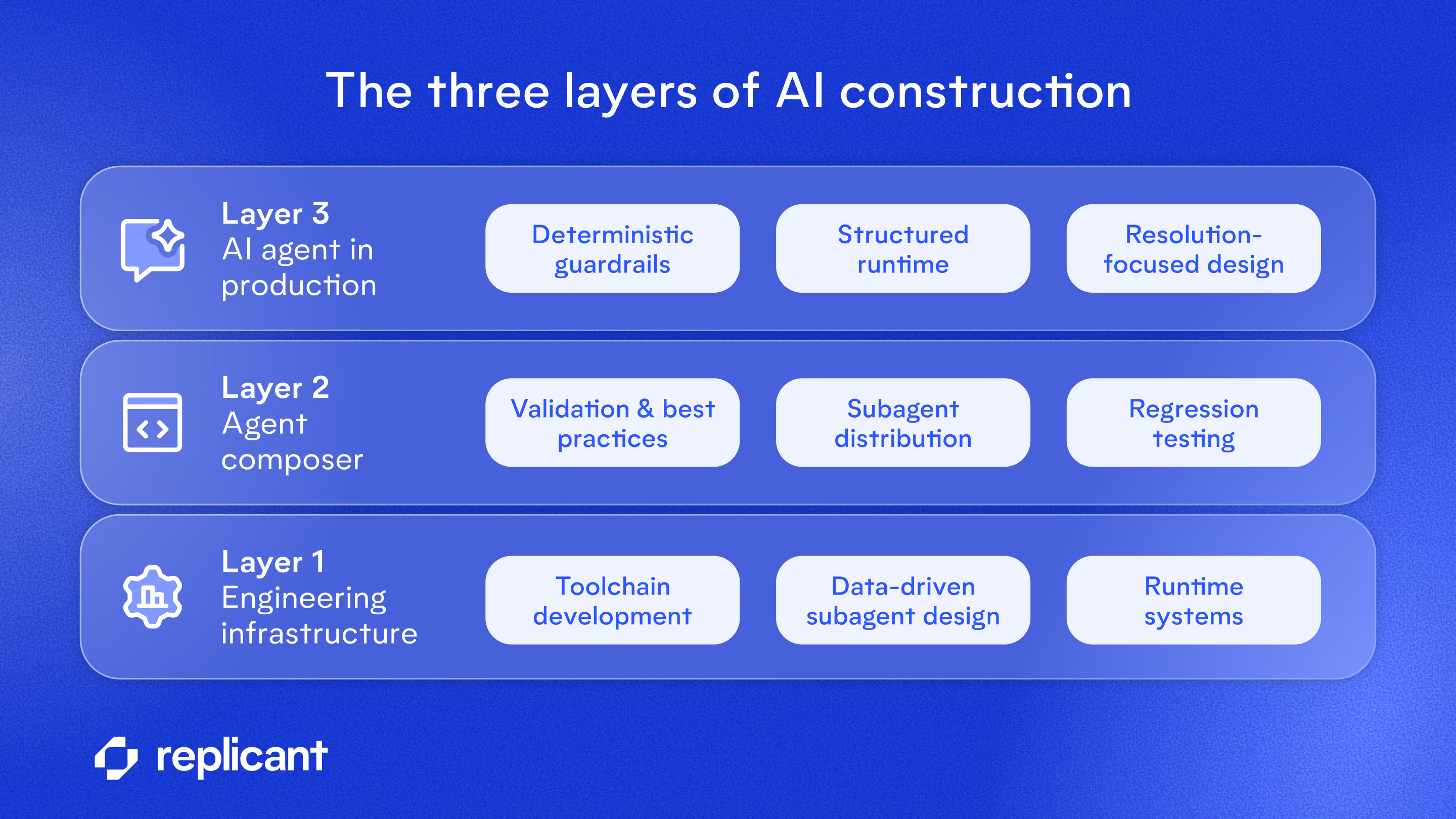
The three layers of AI construction
To deploy a customer service agent that works, whether it’s day one of user acceptance testing (UAT) or an expansion build hundreds of days in, we separate every build process into three distinct layers. Each layer has its own checks, interfaces, evaluations, and intelligence.
Layer 1: AI-powered engineering infrastructure
This is where the construction process begins inside Replicant’s product engineering organization.
Our team uses modern AI coding tools (like Claude Code, Cursor, and Codex) to accelerate the development of the infrastructure behind every agent. These tools don’t run the agent, they help us build the tools that build the agent.
This includes:
- Extending our agent composer toolchain with new capabilities and integration, allowing it to support evolving customer needs and internal best practices
- Developing coding agents and skills that translate real conversations into structured agent definitions with matching test cases replicating the top-performing human agents using insights from our Conversation Intelligence platform.
- Building core architectural systems like configuration abstractions, our low-latency event-driven runtime, evaluation systems, and analytics data pipelines that make it possible for agents to run safely, deterministically, and in real time
At this layer, AI helps us build the infrastructure that builds the AI Agents. We’re using these AI tools as multipliers to engineer better agent-building systems.
Layer 2: building the agent with AI
At the heart of the process is an agent composer: a CLI-based (command-line interface) toolchain that standardizes and formalizes how agents are built and validated.
It’s where our internal subagents and engineers come together to define our external AI Agents’ behavior through structured configuration, not free-form prompts. This, in turn:
- Validates agent definition schemas
- Distributes reusable skills and subagents that know and enforce Replicant’s best practices
- Hooks into shared reusable templates to handle known successful use cases
- Converts real customer calls into regression test cases
- Leverages Replicant’s Conversation Intelligence to model top-performer behavior
As a result, AI agents are not simply “prompted” into existence. They’re rigorously built with a combination of focused AI ideation and human-reviewed definitions.
Layer 3: The AI Agent in production
Once an AI agent has been built and validated, it moves into production. But even here, we maintain strict control:
- Deterministic runtime guardrails ensure safety and compliance
- Structured schemas define allowed paths and responses
- Regression tests run before any change is deployed
- Resolution-focused design ensures the agent’s goal is to solve problems, not just carry conversations
This is how we safely bring AI Agents to life without relying on trial-and-error in live customer environments. You can learn more about Replicant’s guardrail approach here.
Speed comes from systems
Building fast doesn’t mean skipping steps (in fact, this will slow you down in the long run). It comes from automating the right steps.
A few ways our AI-first system compresses the build cycle:
- Drafting conversation flows and test plans based on real human agent conversations, reviewed by our Agent Experience Design team
- Schema validation and best practice enforcement that ensures logic is structurally sound, reviewed by our Delivery team
- Automated test generation that ensures behavioral regressions are caught, validated by Replicant’s QA Team
Velocity doesn’t come from removing humans. It comes from removing mechanical work so humans can focus on ensuring we consistently deliver world class AI Agents.
The result? Faster initial builds. Safer iteration cycles. Zero experimentation on live customers. Less time spent manually re-authoring flows. All without sacrificing quality.
Humans in the loop at every layer
As you can see, Replicant values human-in-the-loop review. This is because certain nuances, such as tone and empathy, are things that AI will never get right on its first try. Enterprise IT leaders don’t want “hands-off AI.” They want controllable automation.
So, we ensure human review is built in:
- Engineers inspect code and schemas generated by AI
- Delivery teams define evaluation criteria
- Agent Experience Designers refine conversation flow
- Deterministic execution ensures runtime constraints are enforced
AI accelerates construction. Humans retain judgment.
Escaping proof-of-concept purgatory
Most contact center AI projects stall not because of weak models but because of weak infrastructure.
What enterprises need isn’t another flashy demo. They need a repeatable way to get to production. They need agents that reflect policy, pass compliance checks, and deliver results without months of manual authoring or post-deployment surprises.
Our ambition is simple: When the contract is signed, the build should already be in motion. Backed by structured tooling, validated definitions, and deterministic controls.
That’s how you escape proof-of-concept purgatory. That’s how you scale.
Conclusion: AI-driven systems as infrastructure
At Replicant, we don’t just build AI Agents. We build the systems and infrastructure that make them reliable, scalable, and fast to deploy.
The future of customer service AI won’t be won by the teams with the best prompts. It’ll be won by the teams with the best pipeline for building, validating, and evolving agents safely. That’s what we’ve built. And that’s how we move customers from waitlists to workflows faster than anyone else.
AI isn’t magic. It’s infrastructure.
Schedule time with an expert to learn more about how Replicant can transform your contact center with AI.