


.svg)


Conversation design used to be about control. Control over flows. Control over wording. And control over users’ responses.
As a result, conversation designers would focus on mapping users’ journeys with high precision. We’d diagram every possible branch plus anticipate every edge case imaginable. If a user said X, the agent would say Y. If they said Z, they’d be routed to a fallback. Everything was intentional and scripted.
But today, we’re in a different era. Advances in large language models and reasoning-based AI systems have fundamentally changed what conversational agents are capable of. Because agents can now interpret context and intent more reliably, conversation design is less about tightly controlling paths and more about enabling intelligent decisions.
And this era requires a different approach: we have moved from scripting to reasoning. This shift is not just technological, but it marks the evolution of Conversation Design into what we now call Agent Experience Design (AXD).
The old era of scripting
Before the rise of modern large language models and generative AI, carefully designed flows were the backbone of every deployment. Conversation design teams invested a lot of effort in anticipating user behavior: what would someone say when checking an order status? How might they phrase a billing issue? What variations needed to be captured to avoid a fallback?
Every new edge case resulted in another intent, another utterance, or another rule in the system. Precision in phrasing was also critical because the underlying system relied heavily on keyword matching and classification. Thus, a slight deviation in wording could make the experience fail.
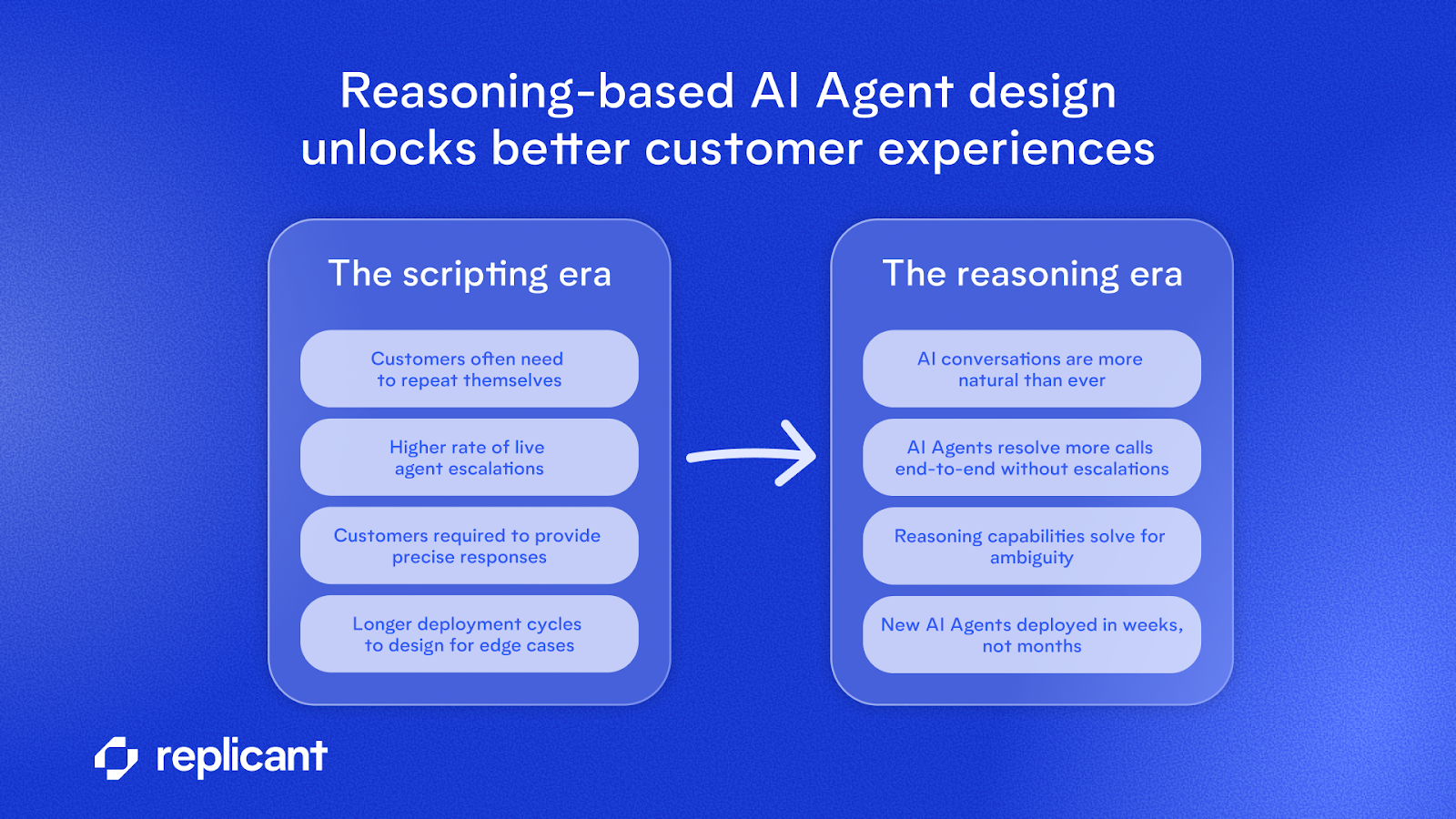
In order to protect the system, conversation designers often constrained the user. Scripts were not always designed just to be helpful, but to limit the range of possible responses. Likewise, open-ended questions and compound requests were risky. Overall, ambiguity was something we tried to avoid rather than explore. As a result, when users stepped outside the expected path, the safest move was escalation to a live agent.
This old approach delivered predictability but lacked flexibility. Scripted systems worked well on the “happy path” but failed quickly outside of it. Maintaining an AI Agent became a continuous effort of patching gaps and adding new branches. Each new scenario required manual updates. We weren’t building agents that understood users; rather, we were building systems that routed users to the right place.
The new era of reasoning
Today, reasoning-based agents prioritize understanding user goals over detecting keywords, which means that users no longer have to phrase their request in a narrowly defined way to be recognized. They can explain their issue naturally, combining context with background information.
Now, the system extracts meaning rather than matching patterns. This fundamentally changes the approach: instead of enumerating every possible way to ask for something, we enable the agent to infer what the user is trying to accomplish.
Therefore, adaptation is central to the interaction. In a scripted world, deviation was treated as error, but in a reasoning-driven system, deviation is simply new information. If a user changes their goal midway through a conversation, the agent adapts. If the user clarifies their situation, the agent incorporates that context into its next decision. The interaction unfolds dynamically rather than mechanically.
More importantly, reasoning systems handle ambiguity differently. Whereas scripted systems saw ambiguity as a trigger for escalation, reasoning systems treat it as a problem to solve. They ask clarifying questions, evaluate possible interpretations, and make informed decisions when appropriate. This shift has important implications. Better ambiguity handling leads to greater containment, more resolved calls, fewer unnecessary transfers, and a significantly better customer experience.
Moving to reasoning does not mean abandoning structure where it is required. There are scenarios, such as regulatory disclosures, authentication steps, or legally mandated language, where exact scripting and strict flow adherence are non-negotiable. Replicant AI agents can blend reasoning with deterministic flows, ensuring that critical moments follow approved scripts verbatim while still allowing the broader conversation to remain adaptive and intelligent.
Why customers notice the difference
Customers may not understand the architectural shift from scripting to reasoning, but they can feel it. They do not care how many intents are configured or how a flowchart is structured. What they care about is being understood and having their problem resolved efficiently.
When an agent adapts to new information without restarting the process, customers notice. When they no longer have to repeat themselves across turns, customers notice. When ambiguity is resolved through intelligent clarification instead of a handoff, customers notice.
The overall effect is a change in perception. Scripted systems often felt like interactive systems disguised as conversations. Reasoning systems have enabled us to bring our AI Agents closer to real dialogue than ever before.
Reasoning at scale requires more than powerful models, it requires experience. At Replicant, we leverage insights from more than 1 billion minutes worth of customer calls, so we can train AI agents to reason in ways that reflect proven design principles, operational best practices, and real-world customer behavior. This wealth of data ensures that reasoning is grounded, reliable, and aligned with the standards conversation designers have refined for years.
Schedule time with an expert to learn more about how Replicant can transform your contact center with AI.
