


.svg)




Managing a call center means juggling dozens of moving parts at once. Agent performance varies from shift to shift. Customer satisfaction scores fluctuate without clear patterns. Training programs struggle to address the right gaps at the right time.
Call center scorecards cut through this complexity. They give managers a structured way to track what matters, spot problems before they spiral, and make decisions based on data instead of gut feelings. With the right scorecard in place, you can measure agent efficiency, maintain service quality, and improve customer experience through metrics that actually move the needle.
This article walks through what call center scorecards are, why they matter, and how to build one that fits your operation. We'll cover the metrics that belong on your scorecard, the step-by-step process for creating one, and the best practices that separate scorecards that collect dust from scorecards that drive real improvement.
Why listen to us?
Replicant has automated over 1 billion agent minutes for enterprise contact centers. Our AI-powered platform analyzes 100% of customer interactions, giving managers complete visibility into performance patterns that traditional sampling methods miss. We've helped contact centers across industries turn raw conversation data into actionable insights that improve both agent performance and customer outcomes.
What is a call center scorecard?
A call center scorecard is a structured tool that tracks agent and team performance through specific, measurable KPIs. It gives you one consolidated view of how efficiently your operation runs, how well agents handle customer interactions, and where service quality needs attention.
Scorecards work because they replace subjective assessments with objective data. Instead of relying on manager memory or random call samples, you get consistent measurements across every interaction. This makes it easier to identify which agents need coaching, which processes create bottlenecks, and which service standards aren't being met.
Most scorecards track a mix of efficiency metrics (how fast agents work), quality metrics (how well they solve problems), and customer experience metrics (how satisfied customers feel after the interaction). When designed well, they become the foundation for coaching programs, training initiatives, and strategic decisions about staffing and process improvements.
Benefits of a call center scorecard
Call center scorecards deliver value across multiple areas of your operation. Here's what changes when you implement one effectively.
Improved performance tracking
Scorecards give you a consistent system for monitoring how agents perform over time. You can see trends across weeks and months, compare performance between team members, and identify whether changes to your process actually improve results. Without a scorecard, performance tracking relies on sporadic observations and incomplete data. With one, you have a complete picture of who's improving, who's struggling, and where your operation stands overall.
Consistent and objective agent evaluations
Manager bias disappears when evaluations follow a standardized scorecard. Every agent gets measured against the same criteria using the same rating scales. This creates fairness in performance reviews and makes it easier to justify coaching decisions, promotions, or performance improvement plans. Agents trust the evaluation process more when they know exactly how they're being measured and can see their scores tracked over time.
Data-driven decision making for managers
Scorecards transform how managers make decisions about their teams. Instead of guessing which training topics matter most, you can see exactly which metrics are lagging and target your coaching accordingly. Resource allocation becomes more strategic when you know which shifts or teams need additional support. Even hiring decisions improve when you can identify the performance patterns that separate your best agents from the rest.
Improved training and targeted development programs
Generic training wastes time and money. Scorecards show you precisely where agents need help, whether that's reducing handle time, improving first call resolution, or handling specific types of customer issues. You can create targeted coaching sessions that address real performance gaps instead of covering material agents already know. Over time, you'll see which training interventions actually work by tracking how scores change after coaching.
Enhanced customer satisfaction and retention
Everything on your scorecard ultimately connects back to customer experience. When agents consistently meet performance benchmarks, customers get faster service, fewer transfers, and better resolutions. Scorecards help you spot the specific behaviors that drive satisfaction scores up or down, so you can replicate what works and eliminate what doesn't. Better agent performance means happier customers, which means better retention rates and more positive word-of-mouth.
Call center performance metrics
Effective scorecards are built on metrics that matter. Here are the core measurements that should shape how you track performance.
Average handle time (AHT)
AHT measures how long agents spend on each customer interaction, including talk time, hold time, and after-call work. It's one of the most fundamental call center efficiency metrics. Lower AHT generally means higher productivity, but you need to balance speed with quality. An agent who rushes through calls might have great AHT but terrible customer satisfaction scores. The key is finding the sweet spot where agents work efficiently without cutting corners on service.
First call resolution (FCR)
FCR tracks the percentage of customer issues resolved in a single interaction without callbacks or escalations. It's one of the strongest predictors of customer satisfaction because customers value having their problems solved quickly and completely. High FCR means your agents have the knowledge, tools, and authority they need to help customers. Low FCR often points to training gaps, unclear processes, or system limitations that force agents to transfer calls unnecessarily.
Customer satisfaction (CSAT)
CSAT measures how happy customers are after an interaction, typically captured through post-call surveys. It's a direct window into whether your service meets customer expectations. CSAT scores can reveal patterns about specific agents, times of day, or types of calls that consistently generate positive or negative feedback. This metric matters because it connects agent performance directly to business outcomes like customer loyalty and repeat purchases.
Net promoter score (NPS)
NPS asks customers how likely they are to recommend your company to others, giving you a broader view of customer loyalty beyond a single interaction. While CSAT measures immediate satisfaction, NPS reflects the cumulative experience customers have with your brand. Strong NPS indicates that your contact center contributes to positive customer relationships, while weak NPS suggests systemic issues that need attention beyond individual agent performance.
Service level agreement (SLA) compliance
SLA compliance tracks whether your team answers calls within target timeframes, typically measured as a percentage of calls answered within a specific number of seconds. It's a critical metric for managing customer wait times and ensuring you have adequate staffing. Missing SLA targets consistently means customers face long hold times, which damages satisfaction regardless of how well agents perform once they pick up the call.
Call abandonment rate
Call abandonment rate measures how often customers hang up before reaching an agent. High abandonment rates signal that wait times are too long or that customers lack confidence in getting their issues resolved. This metric often correlates with understaffing, poor call routing, or periods of unusually high volume. Tracking abandonment alongside other metrics helps you understand whether efficiency problems stem from agent performance or operational capacity.
How to create a call center scorecard
Building an effective scorecard takes planning and iteration. Here's the process that works.
1. Define key performance indicators (KPIs)
Start by identifying which metrics actually matter for your operation. Not every call center needs to track the same KPIs. A technical support center might prioritize FCR and resolution time, while a sales-focused center might emphasize conversion rates and cross-sell success. Choose KPIs that align with your business goals and give you actionable insights about performance. Aim for 5 to 8 core metrics that cover efficiency, quality, and customer experience without creating so much data that managers get overwhelmed.
2. Set performance benchmarks
Benchmarks give context to your metrics by establishing what "good" looks like. You can set benchmarks based on industry standards, historical data from your own operation, or targets tied to business objectives. If your average handle time currently sits at 8 minutes but industry leaders achieve 6 minutes, that gap becomes a clear improvement target. Be realistic about benchmarks. Setting them too high demotivates agents, while setting them too low fails to push performance forward.
3. Develop rating scales
Rating scales translate raw performance data into grades or scores that are easy to interpret. A simple 1 to 5 scale works for most metrics, where 1 represents poor performance and 5 represents exceptional work. You can also use color-coded systems (red, yellow, green) to make performance status immediately obvious at a glance. The important thing is consistency. Every manager should apply the rating scale the same way so agents get evaluated fairly regardless of who reviews their scorecard.
4. Include both quantitative and qualitative metrics
Numbers tell part of the story, but not all of it. Quantitative metrics like AHT and FCR are objective and easy to track, but qualitative assessments capture nuances that numbers miss. Did the agent show empathy? Did they explain the solution clearly? Did they follow up appropriately? Including space for qualitative feedback ensures your scorecard reflects the full picture of agent performance, not just the parts that are easy to measure.
5. Develop a scorecard template
Your template should be clean, organized, and easy to update. Most teams use a simple table or spreadsheet that lists each KPI with space for the agent's score, benchmark, and notes. Include sections for both individual metrics and an overall performance rating. Make sure the template is flexible enough to adapt as your priorities change, but structured enough that every scorecard follows the same format for consistency.
6. Customize based on business goals
Your scorecard should reflect what your business cares about most right now. If reducing costs is the priority, weight efficiency metrics more heavily. If customer satisfaction is slipping, focus on how to improve CSAT and NPS. Different teams within your contact center might need different scorecard variations. Tier 1 support agents might focus on speed and transfer rates, while specialists get measured on resolution quality and customer feedback. Customization ensures the scorecard drives the behaviors that matter most for each role.
7. Test the scorecard with a small group
Before rolling out your scorecard across the entire contact center, pilot it with a small team. This lets you identify problems with confusing metrics, unrealistic benchmarks, or rating scales that don't work in practice. Gather feedback from both managers and agents about what's working and what needs adjustment. Testing with a small group also helps you refine the process for collecting data and conducting reviews before you scale up.
8. Regularly update the scorecard
Business priorities shift. Customer expectations change. New technologies emerge. Your scorecard needs to evolve alongside these changes. Review your KPIs and benchmarks quarterly to make sure they still align with business goals and reflect current performance levels. Add new metrics when they become relevant and remove ones that no longer drive value. Regular updates keep your scorecard useful instead of letting it become outdated and ignored.
How Replicant improves call center scorecards and performance review
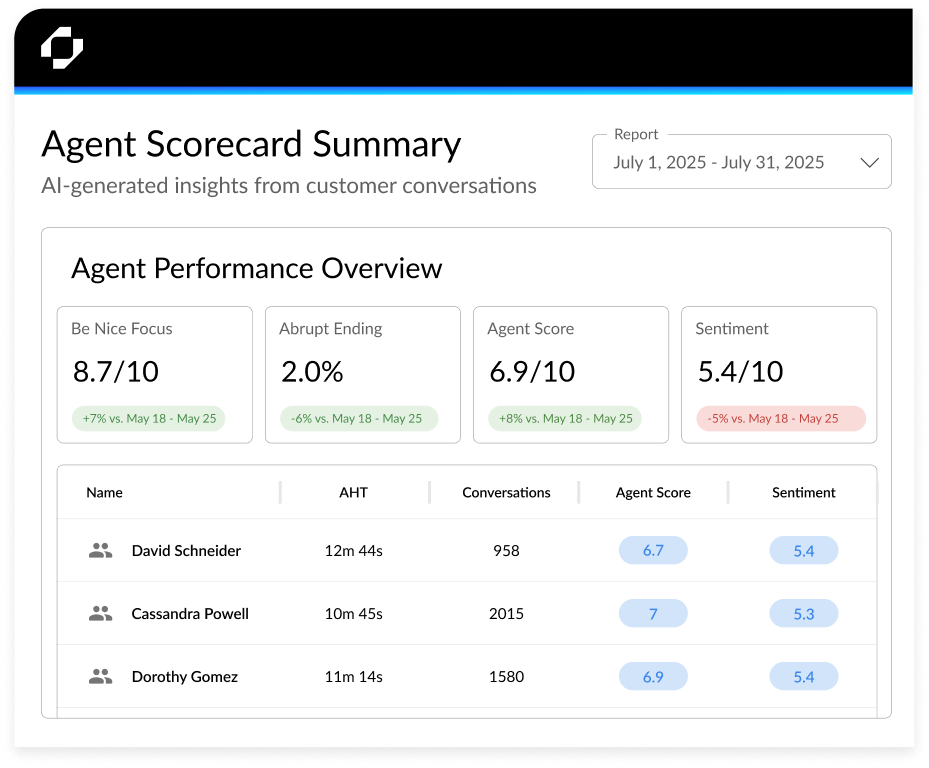
Replicant's Conversation Intelligence solution changes how contact centers track and improve performance. Our AI analyzes every customer interaction, giving you complete visibility into agent behavior, call drivers, and customer sentiment without the time-consuming work of manual call reviews.
Automated data collection
Manual data collection takes hours and only captures a small sample of calls. Replicant automates this entirely by analyzing 100% of customer conversations and extracting the metrics that matter. This means your scorecards reflect actual performance across every interaction, not just the handful of calls that get randomly selected for review. Managers spend less time gathering data and more time acting on insights.
Customizable KPIs and scorecards
Every contact center operates differently. Replicant lets you define exactly which KPIs you want to track and how you want to measure them. You can customize scorecards for different teams, roles, or business units, then adjust them as priorities change. The platform adapts to your needs instead of forcing you into a one-size-fits-all framework.
Real-time performance analytics
Waiting for monthly or quarterly reviews means problems fester for weeks before anyone notices. Replicant provides real-time analytics that show you how agents are performing right now. You can spot trends as they emerge, identify coaching opportunities immediately, and make data-driven decisions about staffing and process changes without delay.
Automated feedback and coaching
Replicant doesn't just track performance, it helps improve it. The platform automatically generates coaching recommendations based on actual call patterns, highlighting specific areas where each agent needs development. This makes coaching more targeted and efficient, helping managers focus on the behaviors that will move performance metrics the most.
"Using Conversation Intelligence, we've seen real improvements at the agent level,” said Danielle Palmiero, Vice President of Customer Experience at Century Support Services. “Someone who was a 6 out of 10 in July is now at a 7.9 out of 10 in September by using both the scorecard and Talk to Your Data."
Historical data for continuous improvement
Performance trends matter as much as current scores. Replicant tracks historical data so you can see how agents improve over time, measure the impact of training programs, and identify patterns that predict success. This long-term view helps you understand whether changes to your processes actually work and where you should focus future improvement efforts.
Integrated reporting and dashboards
Replicant consolidates all your performance data into visual dashboards that make it easy to understand what's happening across your contact center. You can drill down into individual agent performance or zoom out to see team-level trends. Reports are clear, actionable, and designed for quick decision-making instead of requiring hours of analysis.
Best practices for call center scorecards
Building a scorecard is one thing. Using it effectively is another. Here's what separates scorecards that drive real improvement from ones that collect dust.
Regularly update scorecards to reflect changing business priorities
Your scorecard from two years ago probably doesn't reflect what matters most today. Review your metrics quarterly and adjust them based on current business goals, customer expectations, and operational challenges. This keeps the scorecard relevant and ensures agents focus on the right behaviors.
Incorporate self-assessment for agents to encourage accountability
Let agents score themselves before manager reviews. Self-assessment creates ownership and opens up more productive conversations during coaching sessions. When agents evaluate their own performance first, they often identify the same improvement areas managers see, which makes them more receptive to feedback.
Create tiered scorecards for different roles or departments
Not every role needs the same scorecard. Technical support agents, sales agents, and customer service agents all have different responsibilities and should be measured accordingly. Create role-specific scorecards that reflect the unique priorities and challenges each team faces.
Track long-term performance trends to evaluate improvement
Individual scorecard results matter, but trends matter more. Track how each agent's performance changes over months and quarters. This helps you see whether coaching is working, whether certain agents are plateauing, and where you need to adjust your development approach.
Involve agents in the scorecard design process
Agents know which metrics reflect their actual work and which ones don't. Including them in scorecard design improves buy-in and helps you avoid metrics that feel arbitrary or unfair. When agents understand why certain KPIs matter and had a voice in choosing them, they're more motivated to improve their scores.
Choose Replicant for peak call center performance
Call center scorecards give you structure, clarity, and accountability in how you measure performance. They turn subjective opinions into objective data, help you identify improvement opportunities, and create fairness in how agents get evaluated and coached.
Replicant makes scorecards work better by automating data collection, analyzing 100% of customer interactions, and providing real-time insights that drive continuous improvement. Our Conversation Intelligence solution gives you complete visibility into agent performance without the manual work that traditional QA processes require.
FAQ
What should be included in a call center scorecard?
A call center scorecard should include a balanced set of KPIs that measure efficiency (AHT, SLA compliance), effectiveness (FCR, resolution quality), and customer experience (CSAT, NPS). It should also combine quantitative metrics with qualitative behaviors, such as empathy, clarity, and process adherence, to give a complete view of agent performance.
How often should a call center scorecard be updated?
Scorecards should be reviewed weekly or monthly, with KPI targets and benchmarks updated quarterly to reflect changing business goals, customer expectations, and operational realities. Regular updates keep scorecards relevant and prevent them from becoming outdated tools that no longer drive improvement.
How do scorecards help improve agent performance?
Scorecards highlight specific performance gaps, making coaching more targeted and effective. By tracking the same KPIs consistently over time, supervisors can identify patterns, measure the impact of coaching, and ensure agents get actionable feedback. This data-driven approach boosts confidence, fairness, and continuous skill development.
How does AI improve call center scorecard accuracy and effectiveness?
AI-powered Conversation Intelligence analyzes 100% of customer interactions, not just a small sample, so scorecards reflect real performance across every call. AI automatically surfaces coaching opportunities, identifies recurring issues, and provides real-time insights, making scorecards more accurate, objective, and impactful for both agents and managers.
Request a demo to see how Replicant can transform your approach to performance monitoring and help your AI-powered contact center deliver better outcomes for both agents and customers.
