


.svg)




Customer satisfaction scores tell you whether your contact center is meeting expectations or falling short. High CSAT correlates with retention, referrals, and revenue growth. Low scores expose gaps in service quality that drive customers away.
This guide covers 10 strategies to improve CSAT scores, from operational changes to technology investments. These methods focus on what matters most: resolving customer issues quickly, training agents to handle conversations with empathy, and using data to identify where your team can improve.
What is CSAT in call centers?
Customer Satisfaction Score (CSAT) measures how satisfied customers are with a specific interaction. Most contact centers measure it through post-call surveys that ask customers to rate their experience on a scale of 1 to 5.
CSAT differs from Net Promoter Score (NPS), which measures overall loyalty and likelihood to recommend your brand. It also differs from Customer Effort Score (CES), which tracks how easy it was for customers to get help. CSAT focuses specifically on satisfaction with the interaction itself.
CSAT serves as a leading indicator of customer loyalty and call center effectiveness. It connects directly to customer experience, agent performance, and operational efficiency. When CSAT drops, it signals problems in how your team handles calls, resolves issues, or manages wait times.
Why is CSAT important in call centers?
CSAT reflects how well a contact center meets customer expectations. High scores fuel loyalty, revenue, and agent morale, while low scores expose gaps in service quality.
Boost retention rates
Satisfied customers stay longer, reducing churn. Retention costs less than acquisition, and loyal customers spend more over time.
Encourage positive word-of-mouth
High CSAT increases referrals and strengthens brand trust. Customers who have positive experiences tell others, expanding your customer base without additional marketing spend.
Drive revenue growth
Happy customers spend more and increase lifetime value. They're more likely to upgrade services, purchase additional products, and remain customers through price increases.
Improve agent morale
Positive feedback motivates teams and reduces burnout. Agents who consistently receive high CSAT scores feel valued and perform better.
Identify service gaps
Low scores reveal issues like long wait times or poor resolution. CSAT data shows exactly where your contact center needs improvement.
Strengthen competitive advantage
Consistently high CSAT sets your brand apart in crowded markets. Customers choose companies that deliver better service experiences.
10 ways to improve CSAT scores in your call center
1. Prioritize first-call resolution (FCR)
First-call resolution remains the strongest predictor of customer satisfaction. Customers who get their issues resolved on the first contact rate their experience significantly higher than those who need to call back.
Empower agents with comprehensive knowledge bases, expanded decision-making authority, and access to customer history across all channels. Use conversation intelligence to identify common issues that require multiple contacts and develop targeted resolution processes.
Every 1% improvement in FCR typically increases CSAT scores by 1-5%, while reducing operational costs and customer effort. Focus on giving agents the tools and authority they need to resolve issues without escalations or callbacks. For example, Sunrun deployed Replicant’s AI agents to handle payment-related calls, achieving a 4.6 out of 5 CSAT score from customers who interacted with the AI agent.
2. Reduce wait times and abandonment rates
Long hold times create immediate customer frustration before agents even have a chance to provide excellent service. Customers who wait more than 2 minutes become noticeably less satisfied with their overall experience.
Deploy contact center automation for routine inquiries, implement callback options, and use predictive analytics for optimal staffing. Provide accurate wait time estimates and queue position updates to set appropriate expectations.
Reducing average wait times from 3 minutes to 30 seconds can increase CSAT scores by 15-25% while significantly improving customer perception of service efficiency.
3. Implement skills-based routing
Connecting customers with the right agent immediately eliminates transfers and ensures expert problem resolution. Customers who reach a specialist on the first try are far more likely to have their issues resolved quickly.
Create detailed agent skill profiles, implement intelligent routing algorithms, and continuously update skill assignments based on performance data and training completions. Match customer needs to agent expertise in real time.
Skills-based routing typically improves first-call resolution by 20-30% and increases CSAT scores by connecting customers with agents who can solve their specific issues effectively.
4. Focus on agent soft skills training
Technical knowledge alone doesn't drive satisfaction. Customers value empathy, active listening, and communication skills just as much as getting the right answer.
Develop comprehensive soft skills programs covering empathy, de-escalation techniques, active listening, and positive language. Use conversation intelligence to identify specific coaching opportunities from actual customer interactions.
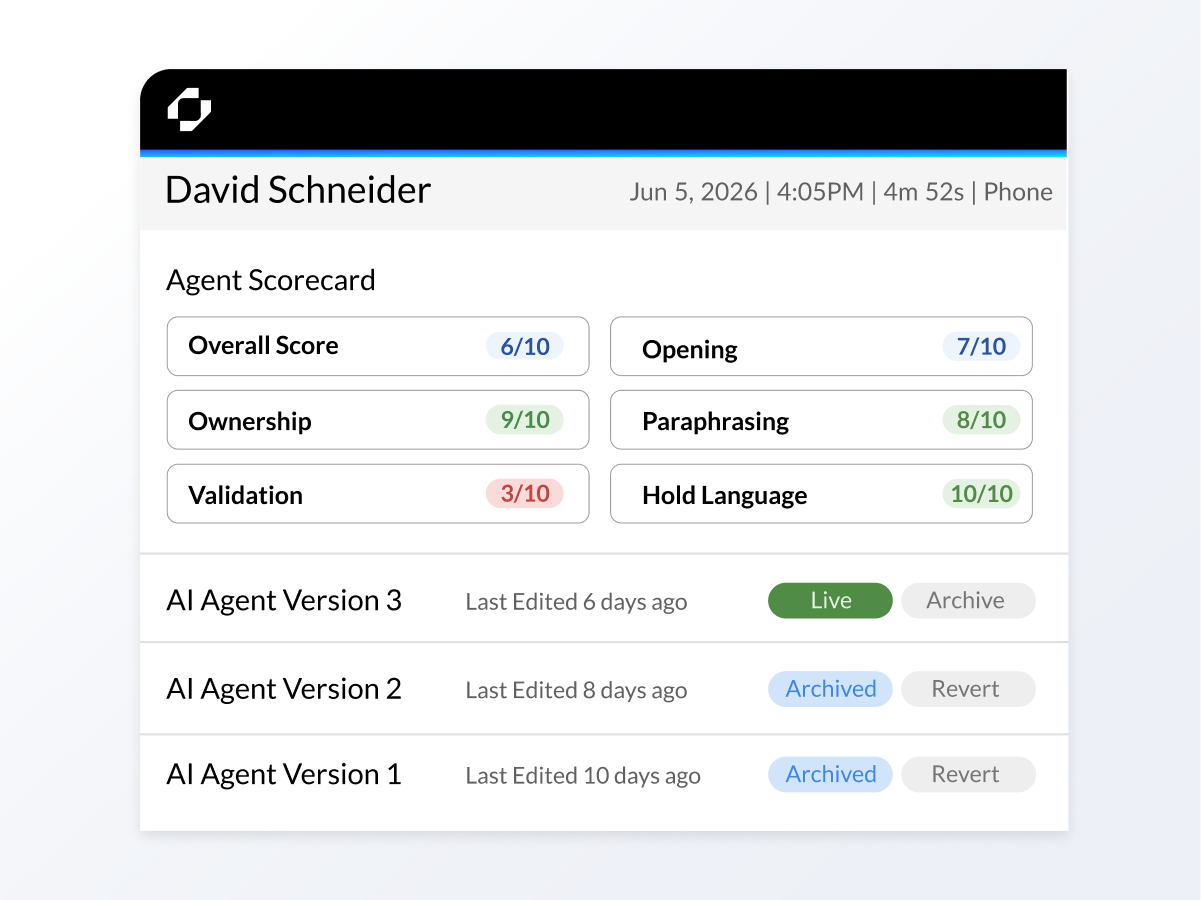
Rather than analyzing 1-2% of customer conversations to mine for coaching opportunities, use Replicant’s Conversation Intelligence to turn on the lights in your contact center by analyzing 100% of all conversations in real-time.
“Using Conversation Intelligence, we’ve seen real improvements at the agent level,” said Danielle Palmiero, VP of Customer Service at Century Support Services. “Someone who was a 6 out of 10 in July is now at a 7.9 out of 10 in September by using both the scorecard and Talk to Your Data."
Agents with strong soft skills consistently achieve 10-15% higher CSAT scores and handle difficult situations more effectively, reducing escalations and repeat contacts.
5. Personalize customer interactions
Customers expect agents to understand their history, preferences, and previous interactions without repeating information. Generic service experiences frustrate customers who feel like just another ticket number.
Integrate CRM systems with call center platforms, create unified customer profiles, and use conversation intelligence to identify individual customer preferences and communication styles. Replicant integrations connect directly with leading CRM and contact center platforms to create unified customer profiles because agents should see relevant context before they answer the call.
Personalized service experiences can increase CSAT scores by 20-30% as customers feel valued and understood throughout their service journey.
6. Monitor and act on customer sentiment
Real-time sentiment analysis enables immediate intervention when interactions turn negative. Supervisors can step in before a frustrated customer becomes an angry one.
Deploy AI-powered sentiment monitoring that alerts supervisors to negative interactions in progress, enabling coaching interventions or call escalations before customer dissatisfaction worsens. Track sentiment trends to identify systemic issues. Replicant safety and security protocols ensure customer data remains protected during real-time sentiment analysis.
Proactive sentiment monitoring and intervention can recover 60-70% of negative interactions, preventing low CSAT scores and potential customer churn.
7. Optimize self-service options
Effective self-service allows customers to resolve simple issues quickly without agent assistance. Customers prefer solving straightforward problems themselves when the tools work well.
Create intuitive IVR systems, comprehensive FAQ databases, and AI-powered chatbots that handle routine inquiries effectively while seamlessly transferring complex issues to human agents. Self-service should feel helpful, not like a barrier.
Well-designed self-service options can resolve 40-60% of simple inquiries, reducing wait times for complex issues and improving overall customer satisfaction.
8. Establish proactive customer outreach
Anticipate customer needs and address issues before they become problems that require reactive support. Proactive communication shows customers you care about their experience.
Use predictive analytics to identify at-risk customers, implement proactive notification systems for service disruptions, and create outreach programs for customer check-ins and satisfaction follow-ups.
Proactive outreach can prevent 30-40% of potential service issues and demonstrates commitment to customer success, significantly boosting satisfaction scores.
9. Create omnichannel consistency
Customers expect seamless experiences whether they contact via phone, chat, email, or social media. Inconsistent service across channels damages trust and frustrates customers who have to repeat information.
Implement unified agent desktops, consistent training across all channels, and integrated conversation history that allows agents to continue interactions regardless of channel switching. A customer who starts on chat should be able to call without explaining everything again.
Omnichannel consistency can improve CSAT scores by 15-25% by eliminating customer frustration with repeated explanations and inconsistent service quality.
10. Use conversation intelligence for continuous improvement
Traditional quality monitoring reviews only a small sample of interactions, missing valuable insights from the majority of customer contacts. Most contact centers review less than 5% of calls.
Deploy AI-powered conversation intelligence that analyzes 100% of interactions, identifies satisfaction drivers and detractors, and provides specific coaching recommendations based on successful interaction patterns. Find patterns across thousands of calls, not just the handful your QA team can review.
Comprehensive conversation analysis enables targeted improvements that can increase CSAT scores by 20-35% through data-driven coaching and process optimization.
Transform your CSAT scores with Replicant
These 10 strategies provide a comprehensive approach to improving customer satisfaction, but implementation requires the right technology foundation.
Replicant's AI-powered conversation automation handles routine inquiries that don't require human interaction, reduces wait times, and improves first-call resolution. Conversation intelligence capabilities provide detailed analytics on every customer contact and identify specific coaching opportunities that drive satisfaction improvements.
Contact centers using Replicant see measurable CSAT improvements within weeks of deployment. Here’s how automation works; the platform combines AI for high-volume requests with intelligence tools that help agents perform better on complex calls.
FAQ
What is a good CSAT score for a call center?
A good CSAT score for a call center typically falls between 75% and 85%, though benchmarks vary by industry and customer expectations. High-performing contact centers often exceed 85% by focusing on first-call resolution, short wait times, and consistent service quality across every interaction.
How often should CSAT be measured in a call center?
CSAT should be measured continuously through post-interaction surveys, with results reviewed daily or weekly to spot trends early. Regular monitoring allows teams to address issues before they impact customer loyalty, rather than waiting for monthly or quarterly reports.
How is CSAT different from NPS and CES?
CSAT measures satisfaction with a specific interaction, while Net Promoter Score (NPS) reflects overall brand loyalty and likelihood to recommend. Customer Effort Score (CES) measures how easy it was for customers to resolve their issue. Together, these metrics provide a more complete picture, but CSAT is often the fastest indicator of day-to-day call center performance.
How does AI help improve CSAT scores in call centers?
AI improves CSAT by reducing wait times, increasing first-call resolution, and identifying dissatisfaction signals in real time. Conversation Intelligence analyzes 100% of customer interactions to surface coaching opportunities, sentiment trends, and service gaps, helping teams fix issues quickly and deliver more consistent, satisfying experiences.
Ready to see how Replicant can help your contact center improve CSAT scores? Check out our blog for additional resources or request a demo to learn why contact center leaders choose our solutions for customer satisfaction excellence.
