


.svg)




Contact centers collect vast amounts of data from every customer interaction. Call recordings, chat transcripts, agent notes, disposition codes, quality scores, it all piles up. The problem isn't lack of information. The problem is that most teams only scratch the surface of what that data can tell them.
Leaders struggle to identify patterns that matter. Agents repeat the same mistakes because coaching happens in a vacuum. Customers experience inconsistent service because no one spots the trends that signal bigger problems. The data exists to fix all of this, but extracting actionable insights requires more than pulling reports and hoping something jumps out.
This guide walks through the practical steps for building an analytics practice that drives real operational improvement. We'll cover what contact center analytics actually involves, why it matters for your team's performance, and how to implement a system that turns insight into action.
What is contact center analytics?
Contact center analytics is the systematic collection and analysis of data from customer interactions to improve service quality and operational performance. Every call, chat, email, and text message generates information about what customers need, how well agents respond, and where processes break down.
Data sources span multiple channels. Voice calls produce recordings, transcripts, handle times, and hold durations. Chat conversations create text records with response times and resolution rates. CRM systems track customer history and previous interactions. Agent desktop tools log after-call work time, disposition codes, and notes about each conversation.
Modern analytics platforms consolidate these disparate sources into unified views. Instead of looking at chat metrics in one system, call data in another, and survey results in a third, you see everything together. This integration reveals connections you'd miss when examining channels in isolation.
Key performance indicators form the foundation of contact center analytics. Average Handle Time (AHT) measures how long interactions take from start to finish. First Contact Resolution (FCR) tracks the percentage of issues resolved without follow-up. Customer Satisfaction (CSAT) quantifies how happy customers feel after their interaction. Call sentiment adds another dimension, analyzing the emotional content of conversations to identify frustration, satisfaction, or confusion in customer voices.
Why is contact center analytics important?
Improve customer satisfaction
Customer experience depends on consistency, speed, and resolution. Analytics reveals where your operation falls short on any of these dimensions. When customers wait too long on hold, when they have to call back multiple times for the same issue, when agents give them contradictory information—these problems show up clearly in the data.
Analyzing call patterns identifies friction points in common customer journeys. Perhaps customers calling about billing issues face longer hold times than other call types. Maybe certain product questions consistently require multiple transfers. The data shows you where customers encounter obstacles, and you can remove those obstacles through better routing, improved training, or additional resources.
Sentiment analysis adds emotional context to operational metrics. A call might resolve in an acceptable time frame but leave the customer frustrated because the agent sounded rushed or dismissive. Traditional metrics would mark this as a success, but sentiment analysis catches the dissatisfaction that would otherwise go unnoticed.
Lower operational costs
Contact centers represent significant expenses. Agent salaries, benefits, training, infrastructure, technology licensing, the costs add up quickly. Analytics helps you optimize these costs without sacrificing service quality.
Automation opportunities emerge clearly from conversation data. When you analyze what customers actually call about, patterns appear. Hundreds of calls per week follow the same script: customer wants to check order status, agent looks it up, agent reads back the information, call ends. That workflow doesn't require human judgment or empathy.
Identifying these automation candidates requires examining actual conversations, not just call types or disposition codes. Agents might categorize many different conversations as "account inquiry" when dispositioning, but the actual content can vary wildly. Some involve complex problem-solving that needs human expertise. Others follow simple, predictable patterns perfect for automation.
Staffing optimization becomes more precise with better forecasting data. Historical analytics show call volume patterns by hour, day, week, and season. You staff accordingly, avoiding both understaffing that creates long hold times and overstaffing that wastes money.
Empower agents
Agents perform better when they have clear feedback, adequate tools, and confidence in their skills. Analytics provides the foundation for all three.
Performance feedback improves when it's based on comprehensive data rather than random sampling. Traditional quality assurance reviews a small percentage of calls—maybe 1-2% of total volume. This approach misses the vast majority of an agent's work and creates a narrow view of performance. Conversation Intelligence analyzes 100% of calls, giving managers and agents a complete picture.
“With Conversation Intelligence, we are now hearing our customers’ voices in a way we never have before,” said Cindy Gambosh, Director of Workforce Automation at CorVel. “Instead of guessing why people are calling based on a fraction of data, we’re getting real-time insights across 100% of our calls.”
Best practice sharing becomes easier when you can identify top performers and understand what makes them effective. Analytics reveals which agents consistently achieve high CSAT scores, fast resolution times, and low escalation rates. Listening to their calls and documenting their techniques creates a playbook other agents can learn from.
Removing blockers improves agent performance without requiring behavior change. Analytics might reveal that certain call types consistently take longer because agents have to navigate multiple systems to find information. That's not a training problem, it's a tools problem. Fix the underlying issue, and every agent benefits immediately.
Reduce compliance risk
Regulated industries face strict requirements about what agents must say, what they can't say, and how they must handle sensitive information. Violations carry serious consequences, including fines, legal action, and even reputational damage. Analytics provides the audit trail and monitoring capabilities to maintain compliance consistently.
Disclosure monitoring ensures agents make required statements. Financial services regulations might require specific risk disclosures. Healthcare privacy rules mandate certain consent language. Conversation Intelligence can flag calls where these required elements are missing, allowing supervisors to coach agents before minor oversights become major problems.
Quality assurance becomes more thorough when you can review 100% of interactions instead of small samples. Compliance violations might be rare—perhaps 1 in 500 calls. Random sampling could easily miss them all. Comprehensive analysis catches every instance.
Drive smarter decisions
Business leaders need data to make strategic decisions about resource allocation, product development, and service strategy. Contact center analytics provides direct insight into customer needs, pain points, and satisfaction drivers.
Product feedback emerges naturally from customer conversations. Customers call to ask questions, report problems, or request features. Analyzing these conversations reveals patterns in what confuses customers, what frustrates them, and what they wish your product did differently.
Service strategy decisions benefit from knowing what actually drives satisfaction. Leaders often guess about what customers value most—fast resolution? Friendly agents? 24/7 availability? Analytics removes the guesswork. When you correlate satisfaction scores with other metrics, you discover which factors matter most to your specific customers.
Meet SLAs consistently
Service level agreements (SLAs) commit you to specific performance standards like answer rate, average speed to answer, or maximum hold time. Missing these targets creates customer dissatisfaction and potentially financial penalties. Analytics helps you stay on target through better forecasting and real-time monitoring.
Predictive analytics improves staffing accuracy. Historical data reveals call volume patterns, but sophisticated models go deeper. They account for factors like day of week, time of year, promotional campaigns, and seasonal conditions. More accurate forecasts mean better staffing decisions.
Real-time monitoring allows proactive adjustments. Dashboards show current queue length, average wait time, agent availability, and projected service level performance. When metrics start trending in the wrong direction, supervisors can make immediate changes.
How to perform contact center analytics with Conversation Intelligence
Define objectives and KPIs
Start with measurable goals that tie to business outcomes. What do you actually want to improve? Lower costs? Higher satisfaction? Better agent retention? Faster resolution? Define 3-5 key objectives and identify the specific metrics that will show progress toward each one.
Goals need both structured and unstructured data to tell the complete story. Structured data includes quantitative metrics—average handle time, first contact resolution rate, customer satisfaction scores, transfer rates, and abandonment rates. Unstructured data adds context that numbers alone can't provide. The actual content of customer conversations reveals why metrics move in certain directions.
Conversation Intelligence from Replicant automatically transcribes and tags every interaction, making both structured and unstructured data instantly accessible. The platform categorizes calls by topic, sentiment, outcome, and other dimensions without manual coding or sampling. Key metrics and themes surface in dashboards, ready for analysis.
Collect and structure data
Capture all customer interactions across every channel. Voice calls, chat conversations, email exchanges, SMS messages—every touchpoint generates valuable data. Partial data creates blind spots that distort your understanding of customer experience and agent performance.
Standardize data into searchable, analyzable formats. Raw call recordings and chat logs aren't immediately useful. They need structure like transcription, categorization, tagging, and metadata.
Replicant Conversation Intelligence handles this transformation automatically. The platform transcribes every call with high accuracy, even accounting for accents, background noise, and unclear audio. It applies natural language processing to identify topics, intent, sentiment, and key moments within each conversation. Auto-tagging categorizes interactions by call reason, product mentioned, issue type, and resolution status.
Analyze across channels
Uncover trends in sentiment, call drivers, script adherence, and escalation triggers. Look for patterns that repeat across multiple conversations, agents, or time periods. Individual interactions provide anecdotes. Patterns reveal systemic issues that warrant attention.
Sentiment analysis tracks emotional tone throughout conversations. Customers might start calls frustrated but end satisfied if agents handle things well. Understanding these emotional arcs helps you identify what triggers negative sentiment and what helps recover from it.
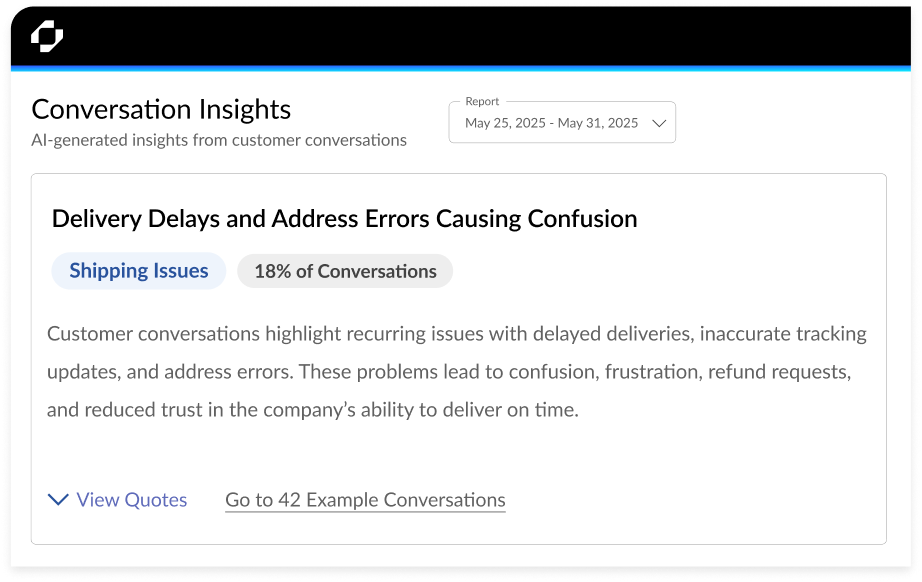
Call drivers show why customers contact you. Order status inquiries, billing questions, technical support, account changes, complaints—each category represents a different type of demand on your resources. Tracking how these drivers shift over time reveals emerging issues or seasonal patterns.
Replicant Conversation Intelligence dashboards surface these insights through visual analytics. Leaders see real-time coaching opportunities flagged automatically—calls where agents struggled, where customers expressed frustration, or where outcomes fell short of expectations. Operations teams spot blockers, system problems, process gaps, or knowledge deficits, that affect multiple agents.
Visualize and share insights
Create role-based dashboards that highlight actionable insights for different teams. Executives need high-level trends and business impact metrics. Managers need team performance data and operational details. Agents need individual performance feedback and improvement resources.
Trends show how performance changes over time. Day-over-day, week-over-week, and month-over-month comparisons reveal whether you're improving, declining, or holding steady. Trend analysis helps distinguish normal variation from meaningful change that requires response.
Replicant Conversation Intelligence provides real-time visualizations organized by disposition, call reason, customer satisfaction, escalation frequency, and agent performance. Leaders see which call types generate the most volume, which produce the highest satisfaction, which take the longest to resolve, and which most frequently require escalation.
Drive coaching and journey optimization
Use conversation insights to design targeted coaching, training, and workflow improvements. Generic training programs deliver generic results. Specific, evidence-based coaching drives meaningful performance improvement.
Coaching moments appear clearly in conversation data. An agent who consistently talks over customers needs feedback on active listening. An agent who excels at de-escalation deserves recognition and could train others on those techniques. Conversation Intelligence identifies these specific coaching needs by analyzing actual performance.
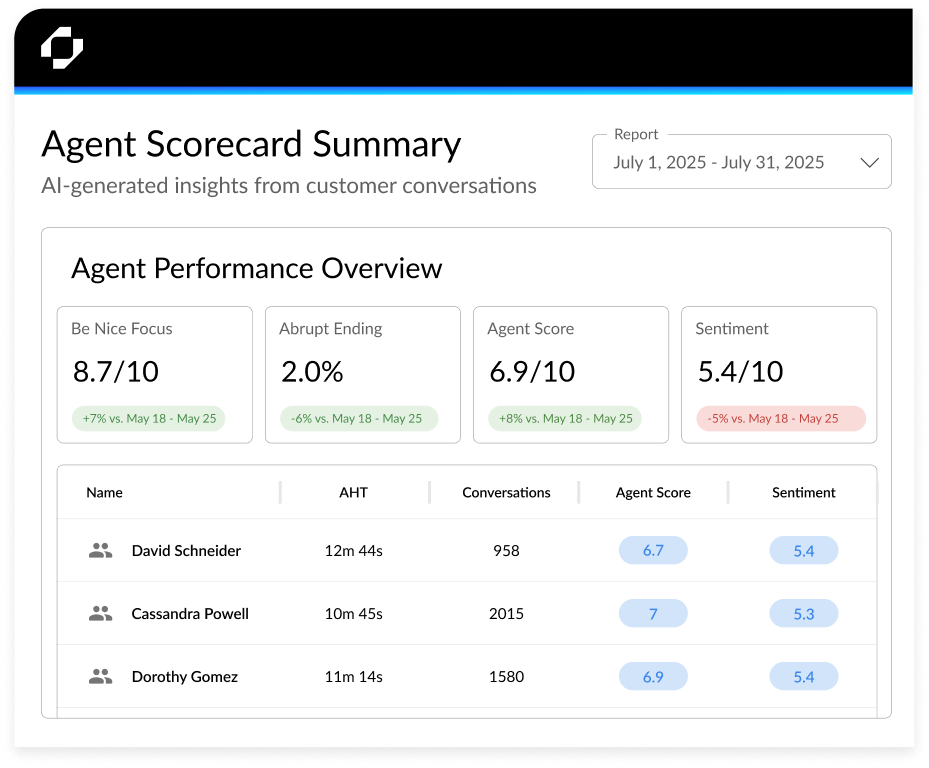
Workflow improvements emerge from identifying conversation drop-offs and pain points. Maybe customers frequently abandon IVR systems at a specific menu. Maybe certain call types always require multiple transfers. Each of these patterns suggests process improvements that could benefit efficiency and satisfaction.
Replicant Conversation Intelligence identifies coaching moments automatically. The system flags poor handoffs between agents or departments, spots conversation drop-offs where customers disengage or escalate, and surfaces situations where agents deviated from best practices.
Monitor, predict and iterate
Establish a feedback loop through regular review of KPIs, conversation patterns, and performance shifts. Analytics are an ongoing practice of measurement, learning, and adjustment.
Weekly reviews keep teams focused on current performance and emerging trends. Managers examine key metrics, discuss changes from the previous week, identify issues that need attention, and plan response actions.
Staffing decisions benefit from predictive analytics based on historical patterns. Call volume forecasts become more accurate when they incorporate multiple years of data, account for known events like holidays and promotions, and adjust for growing or shrinking customer bases.
Replicant Conversation Intelligence enables continuous improvement through comprehensive trend tracking. The platform shows how metrics change over time, highlights shifts in sentiment or call drivers, and identifies new patterns as they emerge. Built-in A/B testing capabilities let you measure the impact of changes to scripts, workflows, or policies.
Best practices for data-driven contact center operations
AI-powered contact centers analyze all interactions, not just samples. Traditional quality assurance reviews 1-2% of calls due to the time required for manual listening and evaluation. Conversation Intelligence analyzes 100% of interactions automatically, giving you complete visibility into performance.
Customize dashboards to avoid one-size-fits-all views. Different roles need different information. Build multiple dashboard views tailored to each audience rather than forcing everyone to use the same generic reports.
Share transcripts, summaries, and tags with managers and agents. Transparency builds trust and enables self-directed improvement. When agents can see their own performance data and listen to their own calls, they can identify improvement opportunities without waiting for manager feedback.
Detect and resolve issues as they occur. Real-time analytics creates opportunities for immediate intervention. If a customer expresses high frustration during a call, supervisors can be alerted to provide assistance or follow up after the interaction ends.
Make analytics part of weekly and monthly routines. Data only drives improvement if people actually use it. Schedule regular times for reviewing metrics, discussing trends, and planning actions.
Turn insights into action for agents and team leads. Analytics without action is just interesting information. When you identify an issue through data, develop a specific plan to address it. Assign ownership. Set deadlines. Follow up to verify that actions were taken.
Making analytics actionable
Contact center analytics should go beyond reporting to actively improve outcomes in real time. The difference between analytics and insights is action. You can measure everything perfectly and still fail to improve if those measurements don't lead to changed behavior and refined processes.
Conversation Intelligence makes analytics actionable without adding manual work. Traditional analytics required teams to listen to calls, code transcripts, and manually build reports. This labor-intensive approach couldn't scale to cover all interactions, so teams settled for small samples and hoped they were representative.
Modern conversation intelligence platforms automate the entire pipeline from data collection to insight generation. Transcription happens automatically with high accuracy. Topic detection and sentiment analysis run on every conversation. Performance metrics calculate in real time. Coaching opportunities flag themselves based on configurable criteria.
These contact center automation solutions don't replace human judgment, they empower it. Managers spend less time pulling reports and more time understanding what the data means and deciding how to respond. QA teams spend less time on administrative work and more time on actual coaching.
FAQ
What is the goal of contact center analytics?
The goal of contact center analytics is to transform raw interaction data—calls, chats, emails, and agent notes—into actionable insights. Instead of reacting to issues after they spiral, analytics helps teams spot patterns early, improve customer satisfaction, reduce repeat contacts, and make smarter staffing and workflow decisions.
Which metrics matter most in contact center analytics?
While every operation is different, the most universally important metrics include Average Handle Time (AHT), First Contact Resolution (FCR), Customer Satisfaction (CSAT), sentiment trends, escalation frequency, and call drivers. Modern Conversation Intelligence platforms automatically surface these metrics without requiring manual QA review.
How does Conversation Intelligence improve contact center performance?
Conversation Intelligence analyzes 100% of customer interactions, revealing trends and coaching opportunities that traditional sampling misses. It identifies call drivers, sentiment shifts, blockers, compliance risks, and agent behaviors. Instead of guessing why performance is slipping, leaders get real-time visibility and can take immediate action.
How can analytics help reduce operational costs?
Analytics uncovers unnecessary repeat contacts, long handle times, and process failures that drive up cost-per-contact. It also reveals which issues can be automated, where routing breaks down, and which workflows create avoidable effort for agents. By addressing these patterns, contact centers reduce volume, improve efficiency, and avoid overstaffing.
Ready to see how conversation intelligence transforms contact center analytics from a reporting exercise into a driver of operational excellence? Request a Replicant demo to explore what we can do for your team.
