Now live: Bot-to-Bot Transfers

Preserving context across AI transfers
As automation expands across regions, languages, and business functions, enterprises will require multiple AI Agents working together. Without structured orchestration, conversations break, context is lost, and callers repeat themselves.
Bot-to-bot Transfers enable voice AI Agents to hand off conversations to other bots while preserving context, conversation history, and user preferences across automated experiences.
The result: modular AI systems that operate as one continuous conversation.
The challenge: scaling beyond a single bot
In complex IVR environments, different use cases require different expertise. AI Agents might specialize in payments, authentication, policy updates, regional routing, or language-specific flows. Traditionally, moving between these experiences means:
- Re-collecting information
- Losing conversational state
- Triggering a live agent escalation
- Or, introducing brittle routing logic
This limits end-to-end automation rates and makes IVR transformation difficult to sustain.
What’s new: AI-to-AI conversation transfers with state preservation
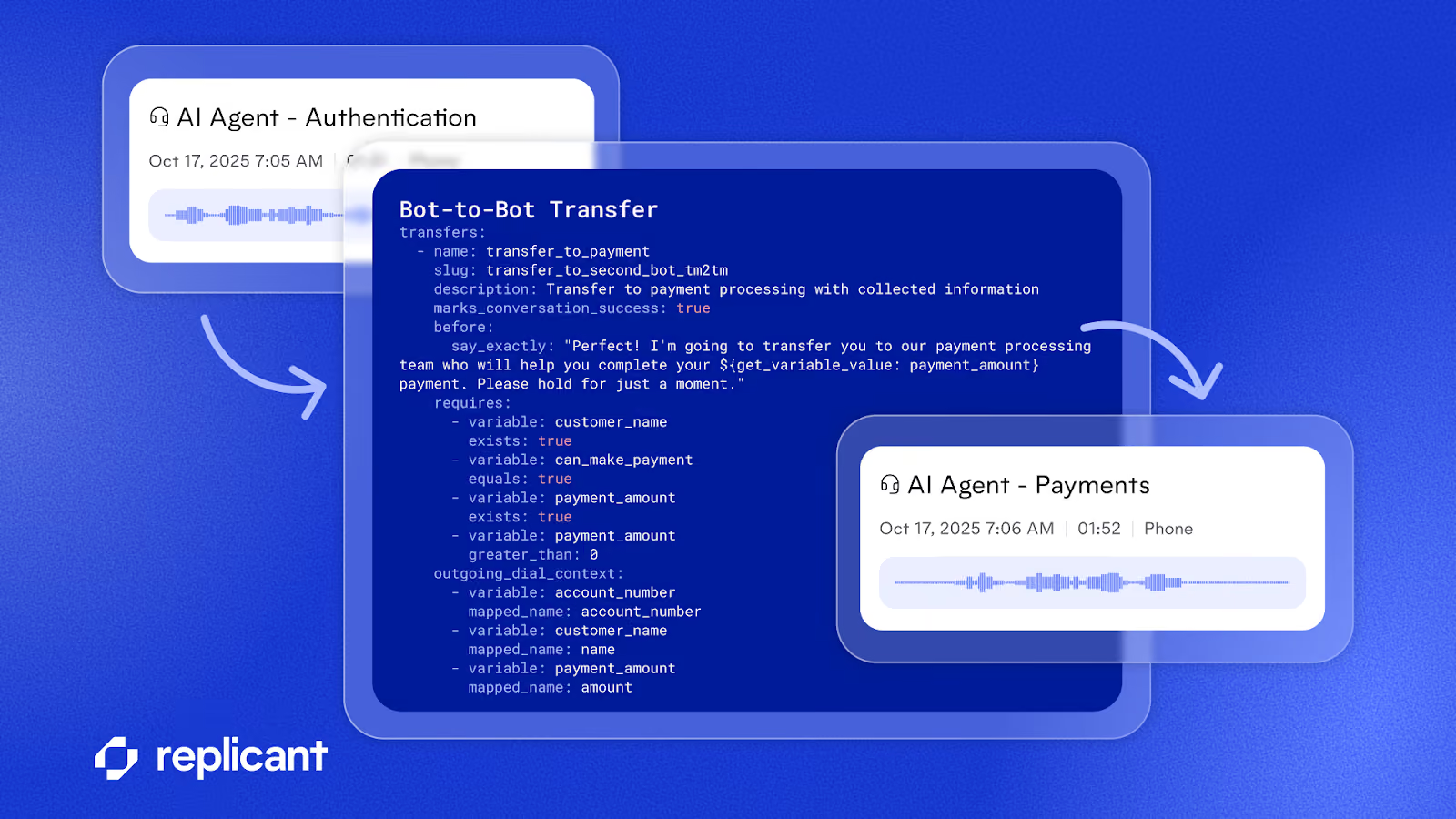
Bot-to-Bot Transfers allow one AI Agent to transfer an active conversation to another without restarting the interaction. During the transfer, conversation history is retained, user preferences and structured state persist, context is passed, and the receiving bot continues the task without re-collecting information. The result:
- Callers do not repeat themselves
- Automation does not reset
- Complex journeys remain fully automated
Now, multiple AI Agents can coordinate complex IVR journeys, functioning as a unified system rather than isolated bots.
Why it matters: AI Agents working together as one system
As enterprises expand automation across regions, languages, and use cases, rigid architectures create friction. Bot-to-Bot Transfers support modular call flows, global call routing, specialized AI Agents, multi-stage workflows, and ultimately higher end-to-end automation rates.
Instead of building one monolithic bot or relying on fragile integrations, teams can design reusable AI components that work together predictably and at scale.
Built for visibility and control
Bot-toBot-Transfers provide clearer insight into how conversations move across automated experiences. Teams can see when a call remains fully automated, when and where transfers occur, and when escalations to live agents happen. This makes it easier to understand call flows, optimize routing flows, and enables more accurate measurement of automation coverage.
Ready to see it in action? Connect with our team to explore how to expand your automation with confidence.