How to reduce call center costs without sacrificing quality

Contact centers operate on tight margins. Labor, technology, and infrastructure consume massive portions of the budget, while pressure to deliver excellent customer service only increases. Leaders face a constant tension: cut costs and risk damaging customer experience, or maintain service levels and watch expenses climb.
This tension creates a false choice. Cost reduction doesn't require sacrificing quality. It requires a data-informed strategy that targets the right cost drivers while protecting, or even improving, the customer experience. The organizations that succeed understand where their money goes, why it goes there, and which levers produce meaningful savings without degrading service.
What is call center cost reduction?
Call center cost reduction is the process of lowering operating expenses while maintaining or improving service quality. It's not about cutting corners or doing less with less. It's about working smarter by identifying inefficiencies, eliminating waste, and making better use of resources.
Major cost drivers include labor, infrastructure, technology, turnover, training, and compliance. Labor typically represents 60-70% of total contact center costs, making it the single largest expense category. Technology and infrastructure account for another 15-20%, covering everything from phone systems to CRM platforms. Turnover creates hidden costs through recruiting, onboarding, and lost productivity during ramp-up periods that can exceed $15,000 per agent.
Both structured and operational efficiencies contribute to sustainable savings. Structured efficiencies come from better processes, technology choices, and organizational design, which are the foundational decisions that shape how your contact center operates. Operational efficiencies emerge from day-to-day execution, like how well you schedule, how effectively agents resolve issues, how accurately you forecast demand.
The distinction matters because different types of savings require different approaches. Structural changes often need upfront investment and time to implement, but deliver lasting benefits. Operational improvements can happen faster but require ongoing attention to sustain.
Why cost reduction matters
Improve profit margins
Lower operating costs directly improve profitability. Every dollar saved on labor, technology, or overhead flows to the bottom line. For organizations with thin margins, these savings can mean the difference between profitability and loss.
Contact centers often operate with single-digit profit margins. Small percentage improvements in efficiency translate to meaningful gains. Reducing cost per call by just $0.50 saves $500,000 annually for a center handling 1 million calls. These savings compound across multiple improvement areas.
Maintain service quality
Cost reduction done right doesn't degrade service, it improves it. When you eliminate repeat calls by fixing root causes, customers get faster resolution and you spend less handling the same issue multiple times. When you automate simple inquiries, customers get instant answers and agents have more time for complex issues that actually benefit from human judgment.
Quality and efficiency often move together rather than in opposition. Long handle times frequently result from poor processes, inadequate knowledge bases, or routing problems, not from agents providing thorough service. Fixing these issues reduces costs while improving the customer experience.
Increase operational efficiency
Efficiency improvements reduce waste without reducing value. Better scheduling means fewer agents sitting idle during slow periods and adequate coverage during peak times. Improved routing gets customers to the right agent faster, reducing transfers and handle time. Streamlined processes eliminate steps that don't contribute to resolution.
Operational efficiency also creates capacity for growth. When you handle current volume with fewer resources, you can absorb increased demand without proportional cost increases. This operational leverage becomes particularly valuable during periods of rapid growth or seasonal spikes.
Reduce turnover costs
Agent turnover costs between $10,000 and $20,000 per position when accounting for recruiting, training, and productivity loss during ramp-up. Turnover rates in contact centers often exceed 30% annually, with some centers experiencing 50% or higher. At those rates, turnover becomes one of the largest cost drivers.
Beyond direct replacement costs, turnover damages service quality. New agents make more mistakes, take longer to resolve issues, and require supervisor support that diverts resources from other priorities. High turnover creates a perpetual training cycle where you're constantly onboarding new staff instead of developing experienced talent.
Improvements that reduce turnover deliver compounding savings. Experienced agents handle calls faster, resolve more issues on first contact, and require less supervision. They also mentor newer team members, improving overall team performance.
Enable scalability
An AI-powered contact center can handle more volume without proportional increases in headcount or infrastructure. This scalability becomes critical during seasonal peaks, promotional periods, or phases of rapid business growth.
“Seasonal hiring used to be a massive effort,” said Chris Alston, Solutions Architect at Bulwark Pest Control. “Bringing on Replicant has reduced the need so significantly that now you hardly even hear about it.”
Traditional contact center scaling required hiring and training agents months in advance, then carrying excess capacity during slower periods. Modern approaches using automation and flexible staffing allow you to scale customer service with much shorter lead times and lower carrying costs.
How to reduce call center costs
Analyze your cost drivers
Understanding where money goes is the first step to spending it more effectively. Break down costs into direct categories, like agent salaries, benefits, technology licenses, facilities, and indirect categories like turnover, quality assurance, and training.
Calculate your cost per call by dividing total operating costs by total call volume. Industry benchmarks range from $3 to $5 per call depending on complexity and channel. Digital channels typically cost less than voice, while complex B2B support costs more than simple consumer inquiries. If your costs exceed these benchmarks, dig deeper to identify why.
Look at cost per resolution rather than just cost per call. A $4 call that resolves the issue completely costs less than two $3 calls addressing the same problem. This perspective shifts focus from minimizing individual interaction costs to maximizing resolution effectiveness.
Focus on high-impact, controllable drivers. You can't change your facility lease overnight, but you can address repeat calls, long handle times, and agent idle time relatively quickly. These operational factors often contribute more to high costs than infrastructure decisions.
Track how costs distribute across call types. Some inquiries naturally cost more to handle than others. Understanding this distribution helps you prioritize automation and self-service investments where they'll deliver the greatest return.
Optimize workforce scheduling
Staffing decisions drive labor costs. Too many agents during slow periods wastes money. Too few during peak times creates long wait times and poor service. The goal is matching capacity to demand as precisely as possible.
Use historical data and volume forecasts to predict staffing needs. Analyze patterns by hour, day, week, and season. Account for known events like holidays, promotions, and billing cycles that affect call volume. Pay attention to intraday patterns, many centers see morning peaks, midday lulls, and afternoon surges that repeat predictably.
Improve utilization by adjusting shift schedules to match demand curves. Traditional 8-hour shifts often create overstaffing or understaffing. Split shifts, staggered start times, and variable-length shifts help you maintain appropriate coverage throughout the day.
Part-time staff and flexible scheduling help cover peak periods without maintaining excess capacity during slow times. Remote work expands your potential labor pool and can reduce facility costs while providing scheduling flexibility that improves agent retention.
Consider seasonal staffing strategies. Rather than maintaining year-round capacity for peak season, use temporary staff or flexible arrangements that allow you to scale up and down. This approach requires more sophisticated workforce planning but can significantly reduce annual labor costs.
Leverage self-service and automation
Automation handles high-volume, repetitive inquiries without human intervention. IVRs, chatbots, and voice AI can deflect up to 70-80% of Tier-1 calls, dramatically reducing the volume agents need to handle.
Customers benefit from instant availability. Automated systems answer questions 24/7 without wait times. For straightforward inquiries, like order status checks, balance inquiries, or password resets, automation provides faster service than agent-handled calls while eliminating queue times entirely.
The key is automating the right interactions. Focus on high-volume, routine inquiries where the resolution path is clear and doesn't require judgment or empathy. Save human agents for interactions involving complex problem-solving, emotional situations, or decisions that benefit from human discretion.
Measure containment rates, which represents the percentage of automated interactions that fully resolve the customer's need without agent intervention. Low containment means customers start with automation but still require agent help, creating frustration while failing to reduce costs. High containment delivers both customer satisfaction and cost savings.
Replicant Voice automates entire conversations, resolving routine requests without human involvement. The platform handles complex, multi-turn conversations that go beyond simple FAQ responses, taking actions in business systems to complete tasks end-to-end.
Improve routing and resolution metrics
How customers reach the right agent matters as much as the agent's skills. Poor routing creates transfers, escalations, and repeat contacts, all of which increase costs and frustrate customers.
Implement skills-based or intent-based routing to connect customers with agents best equipped to help them. When a customer's issue matches an agent's expertise, resolution happens faster with fewer transfers. This targeted routing reduces handle time while improving FCR.
Intent-based routing uses AI to understand why customers are calling and routes them accordingly. Rather than navigating menu trees, customers describe their issue in natural language and get directed to the appropriate resource—whether that's automation, self-service, or a specialist agent.
First Contact Resolution (FCR) is the single most important metric for cost control. Every time a customer has to call back about the same issue, you pay for two interactions instead of one. Improving first contact resolution from 70% to 80% can reduce total call volume and deliver immediate cost savings without any reduction in customer-initiated contacts.
Root cause analysis helps improve FCR by identifying why issues require multiple contacts. Common causes include incomplete information gathering, agents lacking authority to resolve certain issues, system limitations that prevent complete resolution, or knowledge gaps that leave problems partially addressed.
Replicant Conversation Intelligence identifies common blockers and call drivers that affect routing and resolution. The platform analyzes why customers contact you, where conversations break down, and which issues most frequently require escalation or multiple contacts.
Train effectively and retain talent
Generic training delivers generic results. Effective training targets specific skills and behaviors that drive key metrics like FCR, compliance adherence, and product knowledge.
New hire training typically focuses on systems, processes, and policies. Ongoing training should address specific performance gaps identified through QA and analytics. When you know exactly where agents struggle, like handling objections, navigating a particular system, or explaining a specific policy, you can provide focused coaching that produces measurable improvement.
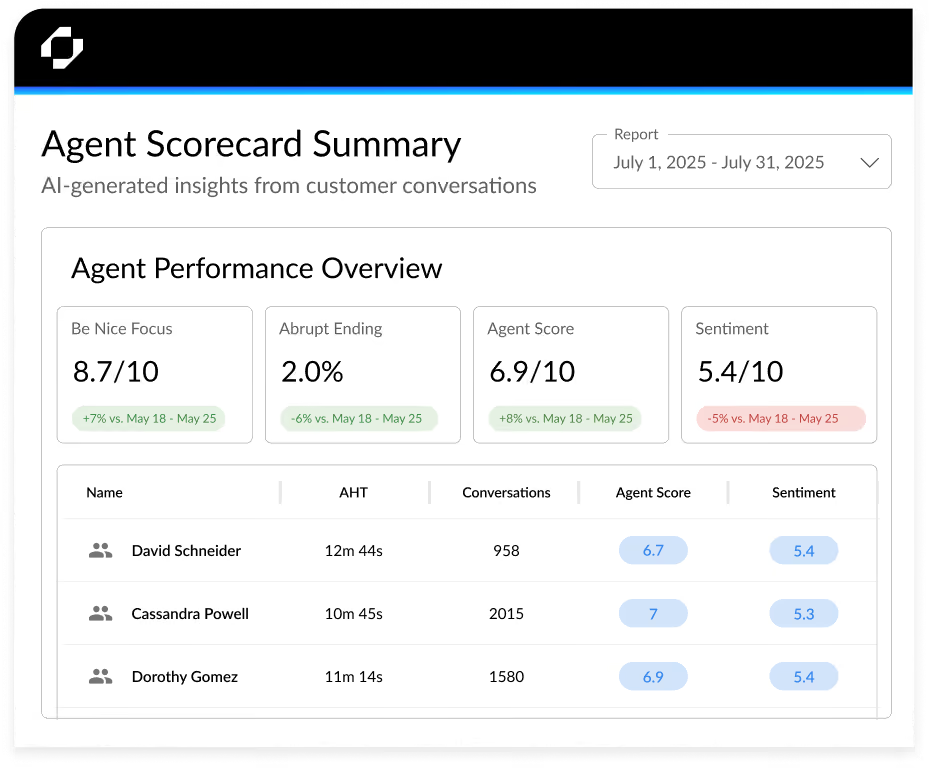
Use real interactions to guide coaching because this precision makes coaching more effective and more efficient.
Retention reduces costs by minimizing turnover-related expenses. Flexible work arrangements, positive team culture, clear career paths, and ongoing development all contribute to keeping good agents. Recognition programs, fair compensation, and reasonable workload expectations also matter.
Replacing a departing agent costs $10,000-$20,000; investing in retention is almost always cheaper. Calculate your annual turnover cost by multiplying your turnover rate by your average replacement cost per agent. That number represents your opportunity for savings through improved retention.
Replicant Conversation Intelligence flags coaching opportunities and provides real transcripts to guide agent training. Managers see exactly where agents need help and can coach based on actual performance rather than assumptions.
Consolidate technologies and monitor continuously
Tool sprawl increases costs through licensing fees, integration complexity, and training requirements. Multiple overlapping tools for QA, coaching, analytics, and workforce management create redundancy and inefficiency.
Each additional platform requires separate licenses, integration work, user training, and ongoing maintenance. The total cost of ownership extends well beyond the initial license fee. Consolidating to fewer, more comprehensive platforms typically reduces total technology spending while simplifying operations.
Cloud platforms reduce maintenance and infrastructure costs compared to on-premises systems. You avoid capital expenditures for servers and equipment, reduce IT staffing needs, and gain automatic updates and scaling. Cloud economics shift technology spending from capital expenses to operating expenses with more flexible cost structures.
Monitor key metrics continuously to spot cost drivers as they emerge. Track repeat calls, silence time, long hold durations, and excessive transfers. These indicators often reveal process problems before they significantly impact costs. Weekly or monthly reviews of these metrics help you identify and address issues quickly.
Create dashboards that connect operational metrics to cost outcomes. Show how changes in FCR, average handle time, and repeat call rates translate to dollars saved or spent. This visibility helps prioritize improvement efforts and demonstrates the value of operational excellence.
Replicant Conversation Intelligence centralizes analytics, QA insights, and performance monitoring in a single platform. This consolidation reduces tool costs and provides comprehensive visibility for cost control through continuous optimization.
Best practices for cost-efficient operations
Optimize staffing using forecasting, not guesswork. Historical data and predictive analytics produce more accurate staffing plans than manual estimation. Small improvements in forecast accuracy generate significant savings by reducing overstaffing and understaffing. A 5% improvement in forecast accuracy can reduce labor costs by 2-3% while maintaining service levels.
Automate low-value, repetitive inquiries with IVR, chatbots, and voice assistants. Reserve human agents for interactions that require judgment, empathy, or complex problem-solving. This allocation ensures customers get the right resource for their needs while using expensive agent time efficiently.
Tie operational metrics to cost outcomes for clearer performance focus. Show teams how improvements in FCR, AHT, and agent utilization translate to dollars saved. This connection helps everyone understand why these metrics matter and creates accountability for cost management.
Engage agents with ongoing coaching and feedback. Agents who feel supported and see a path for growth stay longer, perform better, and require less corrective management. Regular, specific feedback based on actual performance helps agents improve while demonstrating your investment in their development.
Consolidate systems to reduce software and administrative overhead. Every additional platform creates licensing costs, integration work, and training requirements. Fewer, more capable tools usually cost less than many specialized ones while simplifying operations and reducing complexity.
Review KPIs regularly and make cost reduction part of weekly and monthly operations. Cost management isn't a one-time project. It's an ongoing practice of measurement, analysis, and adjustment. Regular reviews help you spot trends early, validate that improvements stick, and identify new opportunities.
Making cost reduction sustainable
Reducing call center costs without sacrificing quality requires a data-informed strategy that addresses key cost drivers systematically. By targeting staffing efficiency, automation opportunities, agent training, and technology consolidation, you can improve both operational efficiency and customer experience.
The organizations that succeed at cost reduction don't make across-the-board cuts. They identify specific inefficiencies and eliminate them through better processes, smarter technology, and more effective use of their people. They measure results, adjust approaches based on data, and maintain focus on sustainable improvements rather than short-term savings that damage long-term performance.
Cost reduction done right creates a virtuous cycle. Lower costs per interaction allow you to invest in better technology, training, and agent support. These investments improve service quality and efficiency, creating additional savings that fuel further improvement.
Request a demo to discover how Replicant’s automation and analytics platform helps you cut costs while delivering better service.
.avif)